
AI-Powered Money or Surveillance Tool? How Algorithms Are Reshaping CBDCs and the Cashless Future
Central banks are rolling out AI-powered digital currencies in 130+ countries. But here's the catch: algorithms that manage your money can also control what you buy, when you work, and whether you're financially invisible. We're not ready for this.

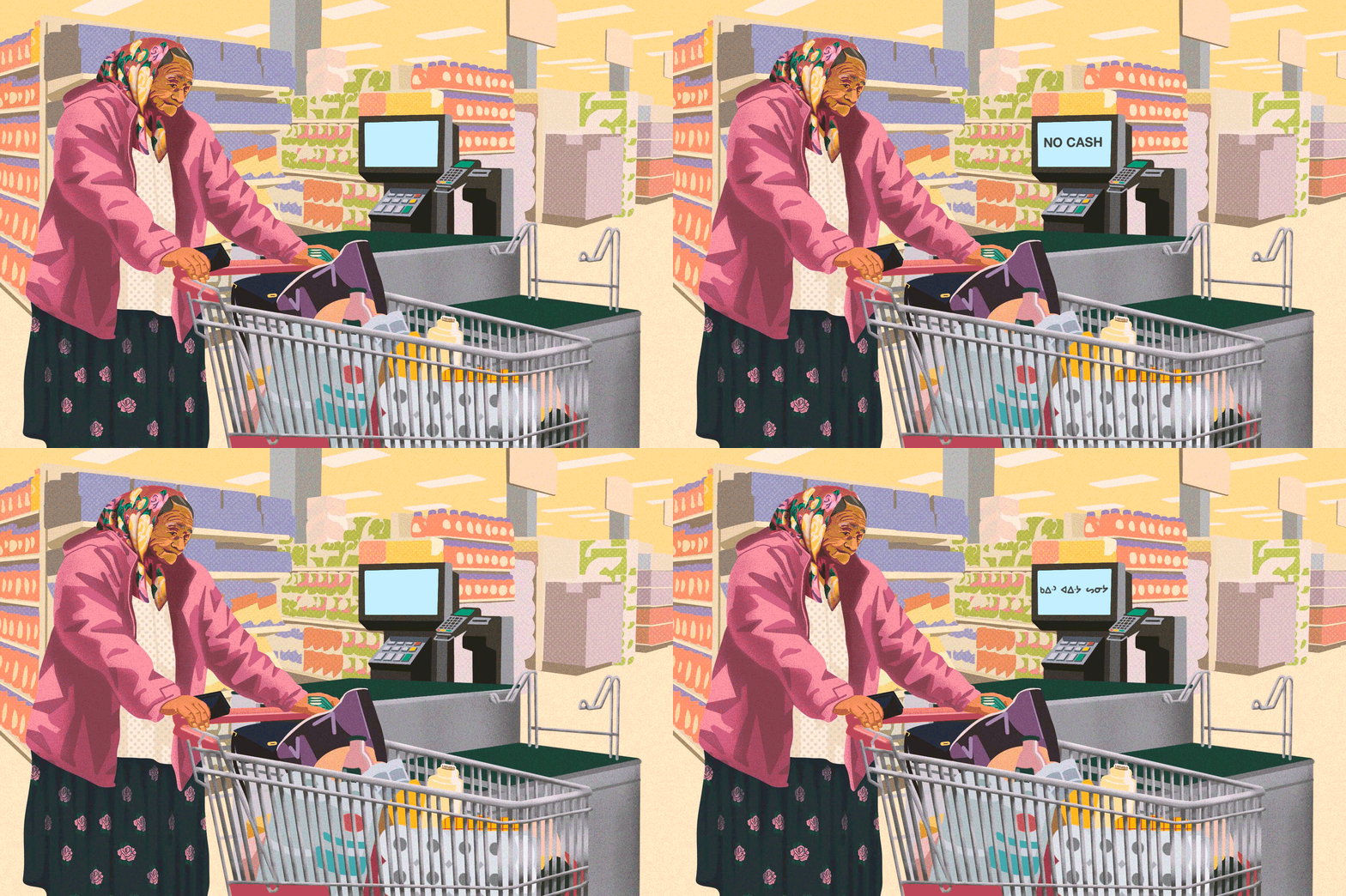
No, we're not ready for a cashless society—not yet anyway. The real issue? AI and automation aren't just making payments faster. They're building a system where algorithms decide if your transaction goes through, whether you "deserve" that purchase, and if your money expires. While digital payments are everywhere and central bank digital currencies (CBDCs) are being tested in 130+ countries representing 98% of global GDP, we're ignoring the fact that cashless = controllable. Going fully cashless isn't just replacing your wallet with an app—it's handing algorithmic control over your financial life to governments and corporations.
But let's be real: cash is already on life support.
Sweden is nearly cashless. China's digital yuan already auto-expires based on government-designed algorithms. Even your local coffee shop probably gives you the stink eye when you try to pay with actual bills.
The writing's on the wall, and it's written in machine learning code.
The AI-Powered Money Revolution Nobody Asked For (But We're Getting Anyway)
Central Bank Digital Currencies aren't crypto. They're government-issued digital versions of traditional currency powered by AI systems that track, analyze, and control every transaction.
More than 130 countries are exploring CBDCs right now. That's 98% of global GDP represented.
The Bahamas already launched theirs. Europe's digital euro is in development. The U.S. is "researching" (read: watching everyone else go first).
Here's what governments actually want: total visibility into money flows, instant transactions, and programmable money that automates tax collection, welfare distribution, and the ability to cut out expensive middlemen like banks and payment processors.
Here's what you get: convenience. Maybe.
How Algorithms Already Control Your Money (And Will Do It Better)
Fraud detection algorithms decide if your transaction goes through. Credit scoring AI determines if you're worthy of borrowing. Robo-advisors manage investments. Automated trading bots move billions in microseconds.
This infrastructure already exists. Now imagine it merged with CBDCs in a fully cashless system.
Your digital wallet could use AI to automatically block "unnecessary" purchases, optimize tax payments in real-time, or restrict spending based on government priorities. It sounds efficient.
Until the algorithm decides you can't afford that concert ticket, or your stimulus check expires if not spent within 30 days, or your account locks because an AI flagged your behavior as "suspicious."
This isn't science fiction. China's digital yuan already has expiration dates built into distributions. The technology exists to make money "smart"—which means controllable, traceable, and automated.
The Future of Work Gets Disrupted by Algorithmic Money
Going cashless fundamentally changes how we work and get paid. Instant wage payments become possible. Gig workers receive micro-payments in real-time. Freelancers invoice and get paid instantly across borders.
Sounds great until automation cuts both ways.
Banks are already using AI to eliminate teller positions. Payment processors automate customer service. Blockchain smart contracts replace accounting departments. CBDCs accelerate this because they remove friction—meaning fewer humans needed to process money.
The cashless society doesn't just change money. It eliminates entire job categories that handle physical currency and traditional payment processing.
And if you're thinking "I'll use crypto instead," cool story. But when your landlord, employer, and government all operate in CBDCs, living entirely in Bitcoin becomes impossible.
The People Algorithms Will Erase Entirely
About 5% of U.S. households are unbanked. Globally? Around 1.4 billion adults lack financial services. Going cashless doesn't inconvenience these people—it financially erases them from the economy.
Elderly folks who never learned smartphones. Rural communities with no internet. Homeless individuals. Undocumented immigrants. Domestic abuse survivors hiding from financial surveillance. People who simply don't trust banks after 2008.
A cashless society requires universal digital access, financial literacy, reliable internet, and devices for everyone. We're nowhere close. Plus, when systems fail—and they will—the entire economy freezes if there's no cash backup.
At least with bills, you can still buy candles during a blackout.
Financial Surveillance: The Hidden Cost of Algorithmic Money
Cash is anonymous. Digital payments are metadata for everyone.
Every CBDC transaction creates data: where you shop, what you buy, when you spend, who you pay. All visible to whoever controls the system—probably your government, possibly corporations, definitely hackers.
Your credit card already does this. But you can still use cash for privacy. Remove that option, and financial surveillance becomes mandatory.
Some CBDC designs include privacy features. Others are explicitly designed for maximum transparency. Authoritarian governments prefer the latter.
Programmable Money: Convenience or Control?
Programmable money is powerful. Governments could implement negative interest rates, forcing spending or watching savings shrink. They could restrict purchases of certain goods. They could freeze accounts instantly without due process.
This isn't hypothetical. It's the technical capability of CBDCs combined with AI decision-making systems.
So... Are We Ready?
No. We're not ready for the infrastructure gaps, privacy implications, or job displacement. We're definitely not ready to hand over algorithmic control of money to governments.
The question isn't whether we'll go cashless. The question is whether we'll demand safeguards, data rights, and financial autonomy before algorithms control every transaction.
Because once cash disappears, your only choice is the system they build.
What People Actually Want to Know
Q: Will CBDCs replace cash completely?
Not immediately, but the trend is clear. Digital payments are growing, and governments are pushing CBDCs. Cash will likely become a niche payment method within a decade in developed countries. Developing nations will take longer.
Q: Can AI prevent fraud better than banks do now?
Yes, but with tradeoffs. Algorithms catch more fraud, but they also create false positives that lock legitimate users out of their money. And algorithmic decisions are often opaque—you don't know why you were denied.
Q: Will I lose privacy with CBDCs?
Almost certainly, unless privacy is legally mandated. Every transaction can be tracked, analyzed, and used for profiling. Private companies at least face legal limits. Governments usually don't.
Q: What happens if the system crashes?
Complete financial gridlock. No ATMs, no purchases, nothing. This is why many experts say cash needs to remain available as a backup system, but "convenience" arguments push against this.
Q: Can I opt out of CBDCs?
Not if they're the only form of legal tender. That's the whole point of going cashless. You either participate in the system or you're financially excluded.
Q: Are cryptocurrencies a better alternative?
Different tradeoffs. Crypto offers privacy and decentralization but volatility, scams, and regulatory uncertainty. Most people will eventually be pushed toward CBDCs because governments control currency.
Related Reading on AI and the Future of Work
Check out how AI is eliminating banking jobs faster than retraining programs can adapt. Or explore algorithmic surveillance and what it means for your financial freedom. And don't miss our deep dive on how automation is reshaping every industry.
```