
AI Is Endlessly Remixing the Bill Clinton Dress Painting—Here's Why That Matters
A 2012 satirical painting of Bill Clinton in a dress hung in Jeffrey Epstein's mansion. Now AI image generators won't stop recreating it. Here's what this says about creative control in the age of automation.

By YEET Magazine Staff
Published October 3, 2025
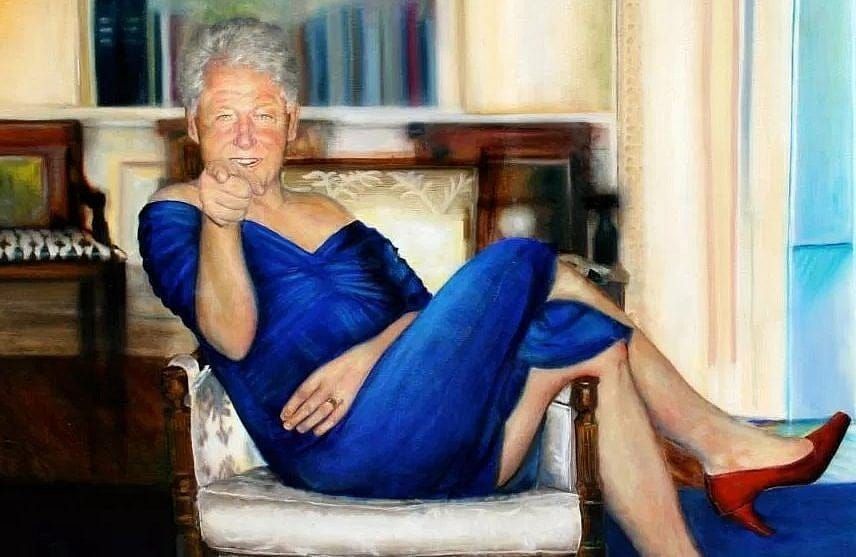
Yes, a painting of Bill Clinton wearing a blue dress and red heels really did hang in Jeffrey Epstein's New York mansion—and now AI won't stop recreating it. Artist Petrina Ryan-Kleid created Parsing Bill in 2012 as satire, sold it at a fundraiser, and lost track of it. In 2019, reporters found it displayed in Epstein's townhouse. She had no idea who bought it. Today, image generators have learned this painting so thoroughly that it's become a permanent template for political absurdity—endlessly remixed without her consent or control. This is what happens when your art becomes training data.
The painting has become internet folklore, endlessly memed and remixed by AI tools that learned about power, scandal, and surrealism from our collective digital obsession with this exact image. What started as one woman's thesis project is now a case study in how algorithms inherit cultural meaning—and how artists lose ownership the moment their work enters the machine.
The Original Scandal
According to the New York Post, the painting hung "prominently — as soon as you walked in — in a room to the right" of Epstein's Upper East Side home.
"Everybody who saw it laughed and smirked," a law enforcement source said.
Ryan-Kleid painted it as part of her master's thesis at the New York Academy of Art. It went up for auction at the school's 2012 Tribeca Ball fundraiser. Someone bought it. She didn't know who.
The model was Christophe Nayel, who has posed for the Academy. He was also surprised when it resurfaced years later in the worst possible context.
The Artist Had No Clue
When Ryan-Kleid learned the painting was in Epstein's house, she told The Daily Beast it was a "complete surprise."
She'd "completely lost track" of the work after the auction.
Her intent? Satire. The dress and pose were meant to comment on how presidents get tangled up in scandal and public perception—which, given the Monica Lewinsky blue dress reference, was pretty on the nose.
She didn't commission it for Epstein. She didn't know he had it. She just made art, sold it, and moved on. That's where her agency ended.
Did Epstein Actually Own the Original?
Here's where it gets fuzzy.
Multiple outlets reported the painting hung in Epstein's home. But Snopes notes it hasn't been independently verified that he owned the original painting versus a print.
Ryan-Kleid told Snopes she wasn't sure how Epstein got it. She first heard about the connection from family after the 2019 media storm.
Prints of Parsing Bill were available online, so it's possible what people saw was a reproduction. But does that make it less weird? Absolutely not.
Why This Painting Matters Beyond the Meme
This isn't just a funny art piece. Given Epstein's history—his power network, his alleged crimes, his high-profile connections—a painting of Clinton in drag takes on darker implications.
Power dynamics: Epstein knew Clinton. They flew together on his private jet. The painting could be seen as mockery, leverage, or both.
Art as commentary: Ryan-Kleid wanted to explore how presidents are wrapped in scandal. The painting does that—just not in the way she expected.
Symbolism or control: Was it satire? A joke? Or a statement of dominance? We'll probably never know.
How AI Learned This Painting (And Won't Stop Using It)
In 2025, Parsing Bill has a second life thanks to AI image generators trained on billions of publicly available images.
Search "Bill Clinton blue dress painting" in any AI tool and you'll get dozens of variations. Some recreate the original. Others add Trump, Obama, or other politicians in similar poses. The internet has turned Parsing Bill into a template for political satire—one that algorithms now understand deeply.
AI models have learned this painting represents scandal, power, absurdity, and cultural transgression. They've internalized its visual language, its symbolic weight, and its place in meme history. So they keep generating new versions, feeding the cycle automatically.
It's a case study in how AI learns cultural context from training data—and how one grad student's thesis project became permanently embedded in the digital consciousness without her consent.
The Copyright Problem No One's Solving Yet
Ryan-Kleid's experience raises urgent questions about artist agency in the AI era.
She created something, sold it, lost control of it, and then watched it become infamous without her consent. Now AI tools remix it endlessly, often without attribution. She gets no credit. No compensation. No say in what happens next.
This is the future of creative work: your art can become a meme, a dataset, a cultural touchstone—and you might not even know until it's too late.
Artists are already fighting back. Lawsuits against AI companies for training on copyrighted work are piling up. But the genie's out of the bottle. Once your image is in a training dataset, it's essentially immortal—copied, remixed, and regenerated forever without your involvement.
Parsing Bill is now part of the collective AI training corpus. Future models will learn from it. Future AI tools will use it. Future remixes will exist. And Ryan-Kleid will likely never see a dime.
What You Can Do Now
Look up Ryan-Kleid's other work: She's a serious artist whose career shouldn't be defined by one viral painting. Support the creator directly.
Read about AI and art ownership: Check out how automation is reshaping creator rights. This case is a preview of bigger fights to come.
Check if your work is in AI datasets: Tools like Have I Been Trained let artists see if their work was used to train image generators without permission.
Demand better AI regulation: The art world needs copyright protections that AI companies actually have to follow.
FAQ
Who painted Bill Clinton in a dress?
Artist Petrina Ryan-Kleid created Parsing Bill in 2012 as a grad school project at the New York Academy of Art. It was meant as satirical commentary on presidential scandal.
Did Epstein commission the painting?
No. Ryan-Kleid sold it at a fundraiser auction in 2012 and didn't know who bought it until years later when reporters discovered it in his mansion.
Was it the original or a print in Epstein's house?
Unclear. Multiple outlets reported it hung in his Upper East Side home, but whether it was the original painting or a reproduction hasn't been independently verified. Prints were available online.
Why do AI image generators keep making variations of this painting?
AI models trained on billions of images learned that this painting represents power, scandal, and political absurdity. So algorithms automatically generate new versions when prompted with similar concepts—it's baked into their training data.
Does Ryan-Kleid get paid when AI generates versions of her work?
No. This is the central problem. Once art enters public datasets, AI companies can use it freely. Artists typically receive zero compensation or credit.
What's the legal status of AI-generated remixes of copyrighted art?
That's still being decided in courts. Multiple lawsuits are testing whether AI companies need permission to train on copyrighted work—but so far, the law is way behind the technology.
Can artists opt out of AI training datasets?
Some tools now offer opt-out mechanisms, but many don't. And once your work is already in a dataset, it's hard to remove.