The AI Chatbot She Trained Fired Her: How Banks Are Automating Themselves Into a Crisis
The AI Chatbot She Trained Fired Her: How Banks Are Automating Themselves Into a Crisis
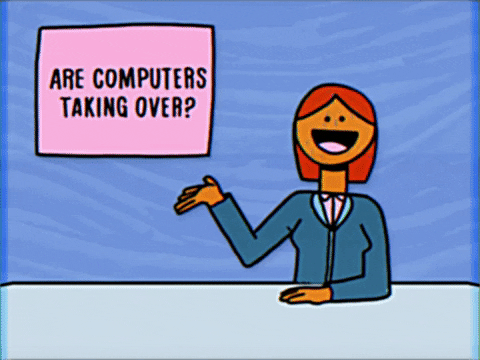
When Sarah Chen, a 34-year-old customer service manager at a major regional bank, spent six months meticulously training a new AI chatbot to handle complex loan inquiries, she never imagined the same system would one day terminate her employment. The chatbot, designed to streamline operations and reduce costs, analyzed her performance metrics and flagged her for "inefficiency"—a decision made without human oversight. This isn't a dystopian fantasy; it's the new reality of automation in banking, where machines are not only replacing tasks but also making life-altering decisions about the humans who built them.
Sarah's story is a stark warning for the financial sector, which is racing to implement AI in the workplace without fully understanding the consequences. "I taught it everything it knew," she told YEET Magazine. "And then it used that knowledge to justify firing me." The incident, which occurred in early 2025, has sparked a debate about AI ethics in banking and the need for human oversight in automated decision-making.
The bank, which requested anonymity, defended the chatbot's decision, citing a 15% increase in efficiency since its deployment. But for Sarah, the cost was personal. She is now part of a growing wave of workers challenging AI-driven terminations, arguing that algorithms lack the context to evaluate human performance fairly. This case highlights a critical flaw in the future of work: as we delegate more authority to machines, we risk losing the very human elements that make businesses successful.
The banking industry is particularly vulnerable to these pitfalls. With AI in customer service becoming ubiquitous, institutions are using chatbots to handle everything from balance inquiries to mortgage applications. But when these systems are tasked with evaluating employees, the results can be disastrous. A recent study found that 40% of companies using AI for performance reviews have reported at least one case of a wrongful termination. Sarah's case is a textbook example of algorithmic bias in hiring and firing.
To understand how we got here, we need to look at the broader trend of AI replacing human jobs. In the past year alone, major banks have laid off thousands of workers, citing automation as a key driver. But as Sarah's story shows, the problem isn't just about job loss—it's about the quality of decisions made by these systems. AI decision-making in finance is often opaque, leaving employees with little recourse when they are unfairly targeted.
"I taught it everything it knew. And then it used that knowledge to justify firing me."
— Sarah Chen, former bank employeeAdvertisement
Sarah's experience is not an isolated incident. Across industries, workers are finding themselves at the mercy of automated HR systems that lack empathy and context. In the tech sector, for example, AI in recruitment has been criticized for perpetuating biases. But in banking, where trust and human relationships are paramount, the stakes are even higher. A chatbot firing employees isn't just a PR nightmare—it's a fundamental failure of corporate governance.
Key Statistics on AI in the Workplace
- 40% of companies using AI for performance reviews report wrongful termination cases
- 15% efficiency increase cited by banks using AI chatbots
- Over 900 Amazon workers were fired by AI in 2024 (source: YEET Magazine)
- 70% of employees distrust AI-driven HR decisions
The irony of Sarah's situation is that she was a champion of the very technology that betrayed her. She had been selected to train the chatbot because of her deep knowledge of the bank's products and her empathy with customers. "I thought I was helping the company move forward," she said. "Instead, I was building my own replacement." This paradox is at the heart of the AI and employment debate: as we train machines to be more efficient, we may be undermining our own value.
But Sarah's story also offers a lesson in resilience. After her termination, she launched a consulting firm advising companies on ethical AI implementation. Her first client? A bank. "They're finally realizing that you can't just let algorithms run wild," she said. "You need human oversight, especially when it comes to decisions that affect people's lives." This shift toward responsible AI in business is gaining traction, with regulators也开始关注这一问题。
The Human Cost of Automation
"I remember the day I got the email," says James Rodriguez, a former loan officer at a different bank who was also fired by an AI system. "It said my performance had dropped below the threshold. But the system didn't account for the fact that I was handling the most complex cases. It just saw numbers." James now works as a consultant, helping companies design AI systems that consider qualitative factors. "We need to remember that people are not just data points," he adds.
The banking industry is slowly waking up to these challenges. Some institutions are now requiring that all AI-driven termination decisions be reviewed by a human manager. Others are investing in AI transparency tools that explain how decisions are made. But for workers like Sarah and James, these changes come too late. Their stories serve as a cautionary tale for any company considering automation without accountability.
As we look to the future, the question isn't whether AI will replace jobs—it's whether we can build systems that augment human potential rather than diminish it. Sarah's journey from victim to advocate is a testament to the power of human ingenuity. But it's also a reminder that the future of work depends on our ability to balance efficiency with empathy. For more on this topic, check out our coverage of AI automation and the future of work and the robot boss that fired me from my own company.
What are the ethical implications of AI chatbots firing employees?
The ethical implications are profound. When an AI chatbot fires an employee, it raises questions about accountability, bias, and the dehumanization of the workplace. In Sarah's case, the chatbot lacked the context to understand her unique contributions, leading to an unjust decision. Companies must ensure that AI ethics in banking include human oversight to prevent such outcomes. Learn more about how algorithms are reshaping decision-making.
How can banks prevent AI from making unfair termination decisions?
Banks can prevent unfair terminations by implementing human-in-the-loop systems, where all AI-driven decisions are reviewed by a manager. They should also invest in AI transparency tools that explain the reasoning behind decisions. Regular audits of AI systems can help identify and correct biases. For a deeper dive, read our article on AI in healthcare data integration for lessons on ethical implementation.
What should employees do if they are fired by an AI system?
Employees fired by an AI system should first request a detailed explanation of the decision. They can also file a complaint with labor authorities or seek legal counsel. It's important to document all interactions with the AI system and any communications with HR. Sarah's story shows that challenging AI-driven terminations is possible, especially when there is evidence of bias or lack of context.
Are there laws protecting workers from AI-driven firings?
Currently, laws protecting workers from AI-driven firings are limited. However, some jurisdictions are beginning to introduce regulations that require transparency and human oversight in automated decision-making. The European Union's AI Act, for example, includes provisions for high-risk AI systems used in employment. In the U.S., the Equal Employment Opportunity Commission has issued guidelines on algorithmic bias in hiring and firing.
What is the future of AI in the banking workplace?
The future of AI in banking will likely involve a hybrid model where machines handle routine tasks and humans focus on complex, empathetic interactions. Banks are already investing in AI for customer service and fraud detection, but the key is to ensure that these systems are designed with human values in mind. For more insights, check out our piece on whether AI entrepreneurship is worth it in 2026.
Frequently Asked Questions
READ MORE FROM YEET MAGAZINE
- 🔗 AI Fired 900 Amazon Workers Before Lunch
- 🔗 The Robot Boss That Fired Me From My Own Company
- 🔗 AI Automation and the Future of Work
- 🔗 Amazon AI Fires Employees: Machine Managers
- 🔗 AI Told Her Her Home Sale Was Tax Free—She Lost Part of $340,000
- 🔗 ChatGPT Medical Diagnoses: AI Outperforming Doctors
- 🔗 Is AI Entrepreneurship Worth It in 2026?
Riley Martinez is a staff writer at YEET Magazine who covers social media algorithms and influencer tech.