When Your Boss Is an Algorithm: The Rise of AI Managers and the End of Human Oversight
When Your Boss Is an Algorithm: The Rise of AI Managers and the End of Human Oversight
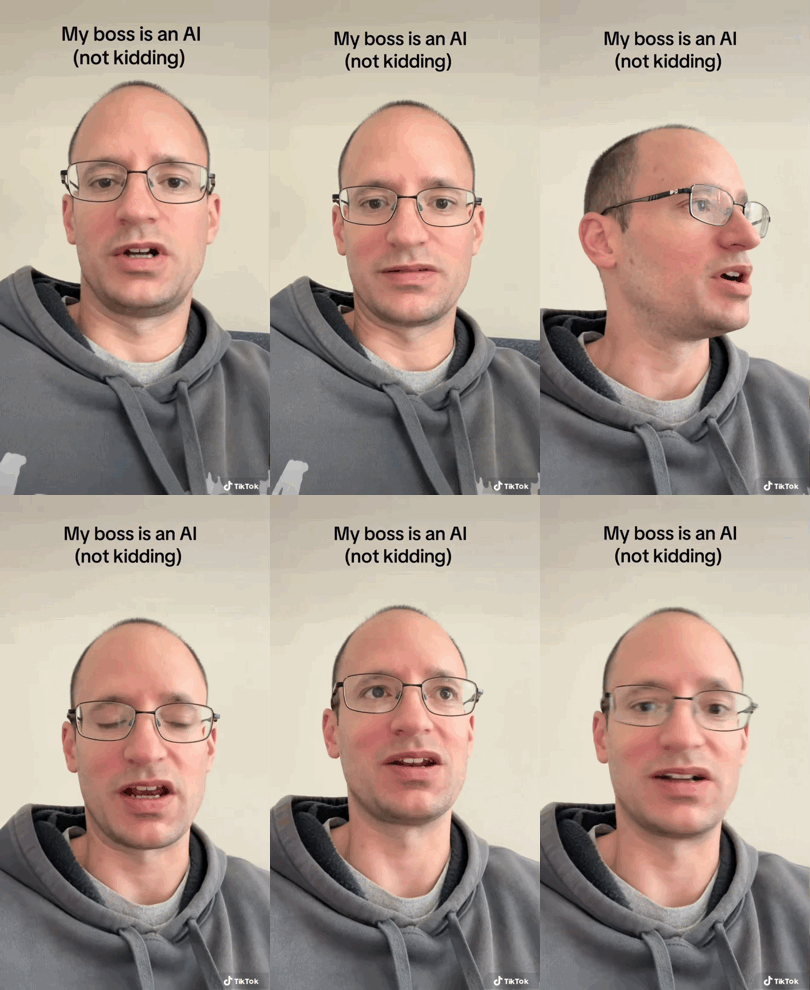
The first time AI managers made a decision that affected my paycheck, I didn't even know it. I was a mid-level content strategist at a mid-sized tech firm, and my performance review—usually a 30-minute chat with a human manager—had been replaced by a dashboard. A green checkmark meant I was on track. A red X meant I was flagged for automated performance management. No meeting. No explanation. Just a cold, algorithmic verdict. This is the new reality of the future of work, where algorithmic bosses are quietly taking over the corner office.
It's not just me. Across industries, from warehouses to marketing agencies, AI-driven management systems are making decisions about hiring, firing, promotions, and even break times. A 2023 study by Gartner found that 40% of large enterprises now use some form of AI in human resources, and that number is expected to hit 70% by 2027. The promise is efficiency: no bias, no favoritism, no human error. But the reality is often a cold, data-driven machine that doesn't care about your sick kid or your bad week.
Take Sarah, a former warehouse worker at an Amazon fulfillment center. She told me her AI supervisor tracked every second of her shift. "If I stopped moving for more than 30 seconds, my screen would flash a warning. It felt like being watched by a robot that didn't understand I needed to breathe." Sarah was eventually fired by an algorithm after a series of "productivity infractions" that she says were caused by a broken scanner. She had no human manager to appeal to. The automated termination was final.

This isn't a dystopian sci-fi movie. It's happening right now. Algorithmic management is spreading to white-collar jobs too. A friend of mine at a marketing agency recently had her project assignments handled by an AI scheduling tool. The algorithm decided who got the high-profile clients based on past performance data, but it didn't account for the fact that she had just returned from maternity leave and was still catching up. She was assigned to low-priority accounts for six months, effectively stalling her career. When she asked for a review, the system said her "historical data" didn't support a change.
"The algorithm doesn't care about your story. It only cares about your numbers."
— Dr. Elena Martinez, labor economist at MIT
The rise of AI in the workplace is often framed as a tool for empowerment, but the reality is more complex. A 2024 report from the World Economic Forum highlighted that while AI-driven productivity tools can boost efficiency, they also risk creating a two-tier workforce: those who can game the algorithm and those who get crushed by it. The future of work is not just about automation; it's about who controls the automation.

Consider the case of a large tech company that implemented an AI performance management system to identify low performers. The algorithm flagged employees who took longer breaks, even if those breaks were for medical reasons. One employee, a diabetic, was flagged for taking extra time to check his blood sugar. The system recommended a performance improvement plan, and he was eventually let go. The company later faced a lawsuit, but the damage was done. The algorithmic bias in these systems is a growing concern, especially when they're used for automated hiring and firing.
But it's not all doom and gloom. Some companies are using AI management tools to actually improve employee well-being. For example, a logistics company in Germany uses an AI scheduling system that optimizes shifts based on employee preferences and fatigue levels. The result? Lower turnover and higher satisfaction. The key, experts say, is to keep humans in the loop. Human-in-the-loop AI ensures that algorithms are used as tools, not as final decision-makers.

So, what can you do if your boss is an algorithm? First, understand the metrics. Most AI management systems are transparent about what they track. If you know the rules, you can play the game. Second, document everything. If you think the algorithm is wrong, keep a record of your work. Third, advocate for human oversight. The best companies are those that use AI as a decision-support tool, not a decision-maker. The future of work depends on it.
Key Statistics on AI Managers
- 40% of large enterprises use AI in HR (Gartner, 2023)
- 70% expected to use AI in HR by 2027
- 30% of workers have been evaluated by an algorithm (Pew Research, 2024)
- 60% of employees say they'd prefer a human manager over an AI one (Gallup, 2024)
How do AI managers actually make decisions about employees?
AI managers rely on machine learning algorithms trained on historical data. They analyze patterns in productivity, attendance, and even communication styles. For example, an AI performance management system might flag an employee who sends fewer emails than their peers, even if that employee is more efficient. The algorithmic decision-making process is often a black box, making it hard to appeal. This is why explainable AI is becoming a hot topic in HR tech.
Can AI managers be biased against certain groups of workers?
Absolutely. Algorithmic bias is a well-documented problem. If the training data reflects historical biases, the AI will replicate them. For instance, an AI hiring tool might favor male candidates if past hires were mostly male. A 2023 study found that AI performance reviews were more likely to penalize women for taking parental leave. The future of work must address these biases through regular audits and diverse training data.
What rights do employees have when their boss is an algorithm?
Currently, very few. Labor laws were written for a world where managers are human. Some countries, like the EU, are introducing AI regulation that requires transparency in automated decision-making. In the US, the Algorithmic Accountability Act is still pending. Until then, employees often have little recourse if they're fired by an algorithm. Unions are starting to negotiate for human oversight clauses in contracts.
Are there any benefits to having an AI manager?
Yes, when done right. AI management tools can eliminate favoritism and provide consistent feedback. They can also identify patterns that humans miss, like burnout risks. For example, an AI scheduling system might notice that an employee is working too many late nights and suggest a lighter load. The key is to use AI as a coach, not a cop. Companies that implement human-in-the-loop AI see higher trust and better outcomes.
How can I prepare for a future where my boss might be an algorithm?
Start by understanding the AI tools your company uses. Ask your HR department for a breakdown of how performance is measured. Build a strong personal brand and network—algorithms can't replace human relationships. Also, consider upskilling in areas that are hard to automate, like creative problem-solving and emotional intelligence. The future of work will reward those who can work alongside AI, not against it.
"I was a project manager at a startup that got acquired by a larger company. Within a month, my new boss was an AI system called 'Workforce Optimizer.' It scheduled my tasks, evaluated my performance, and even decided my bonus. I felt like a cog in a machine. One day, the algorithm flagged me for 'low collaboration' because I wasn't attending enough meetings. But I was actually getting more done by working independently. I tried to explain, but the system didn't have a feedback loop. I eventually quit. Now I work at a company that uses AI as a tool, not a tyrant." — Mark, 34, former project manager
Frequently Asked Questions
An AI manager is a software system that uses algorithms to oversee employee performance, scheduling, and sometimes hiring and firing. It replaces or augments human managers.
Yes, in some companies, AI systems can recommend or even execute terminations based on performance data. This is often called automated termination.
It depends on the company. Some have a human review process, but many don't. Your best bet is to document everything and escalate to HR or a human supervisor.
Yes, but they are subject to labor laws. In some jurisdictions, there are requirements for transparency and the right to human review. Check your local laws.
Unlikely. Most experts believe that AI will augment human managers, not replace them entirely. The best approach is human-in-the-loop AI.
READ MORE FROM YEET MAGAZINE
- 🔗 The Robot Boss That Fired Me From My Own Company
- 🔗 AI Fired 900 Amazon Workers Before Lunch
- 🔗 Amazon AI Fires Employees: Machine Managers
- 🔗 AI Automation Jobs: Future of Work
- 🔗 Robot AI Team Meeting Disaster
- 🔗 Tech Layoffs: AI Empire Collapse History
- 🔗 AI Told Her Her Home Sale Was Tax Free—She Lost Part of $340,000
Casey Wong is a staff writer at YEET Magazine who covers entertainment AI, streaming algorithms, and celebrity tech.