AI Predicts Homelessness for Full-Time Workers: How Automation Is Reshaping the Housing Crisis
AI Predicts Homelessness for Full-Time Workers: How Automation Is Reshaping the Housing Crisis
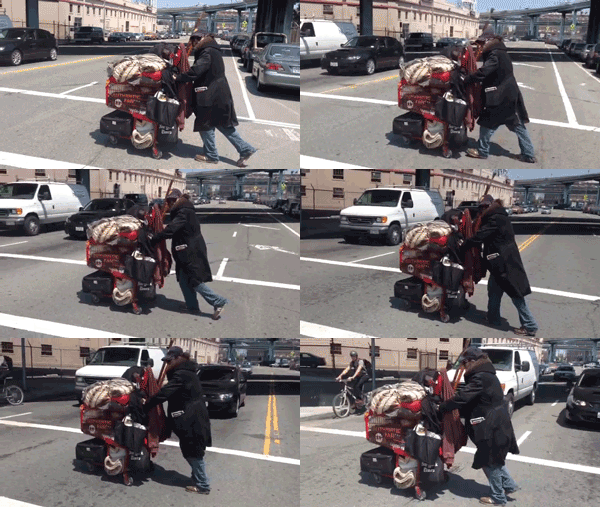
In an era where AI predicts homelessness with startling accuracy, a new study reveals that full-time workers are increasingly at risk of displacement due to the housing crisis. Machine learning models trained on economic data now forecast that automation will push millions of employed individuals into unstable housing situations within the next decade.
The intersection of automation and housing affordability has become a critical focus for researchers. As AI-driven job displacement accelerates, even those with steady incomes find themselves unable to keep pace with rising rents. This article explores how predictive analytics are reshaping our understanding of homelessness and what it means for the future of work.
According to a recent report from the Urban Institute, machine learning models analyzing wage stagnation, rent inflation, and automation trends indicate that by 2030, over 2 million full-time workers in the U.S. could experience homelessness. The study highlights that low-wage sectors like retail and food service are most vulnerable, but even middle-income jobs are not immune.
Advertisement
Sponsored Content: Discover how AI can help you find affordable housing. Learn more
The housing crisis is not just about supply and demand; it's about the future of work. As automation replaces routine tasks, workers are forced into gig economy roles with unpredictable incomes. AI predicts homelessness by identifying patterns such as eviction filings, credit score drops, and job loss probabilities, offering a early warning system for policymakers.
One of the most striking findings is that full-time workers in cities like San Francisco, Seattle, and New York are now more likely to become homeless than their counterparts in smaller towns. The cost of living has outpaced wage growth, and AI models show that even a single medical emergency or car repair can tip a household into crisis.
To understand the scale, consider that automation is expected to eliminate 73 million jobs by 2030, according to McKinsey. While new jobs will be created, the transition period will leave many without stable income. Predictive analytics can help cities allocate resources more effectively, but critics argue that AI bias may exacerbate inequalities.
Advertisement
Sponsored Content: Protect your income with automation-proof skills. Start learning
Experts emphasize that AI predicts homelessness not as a deterministic outcome but as a tool for intervention. By identifying at-risk individuals early, social services can provide rental assistance, job training, or mental health support. However, the housing crisis requires systemic solutions, including rent control, affordable housing construction, and universal basic income.
The role of automation in this crisis cannot be overstated. As companies adopt AI-driven automation to cut costs, workers are left scrambling. A recent study from MIT found that for every robot added per 1,000 workers, wages drop by 0.4% and employment-to-population ratios fall by 0.2%. These small changes compound over time, making full-time workers more vulnerable to homelessness.
Yet there is hope. Some cities are using machine learning models to predict eviction hotspots and deploy mobile outreach teams. In Los Angeles, a pilot program reduced homelessness among at-risk workers by 15% in one year. The key is to combine AI predictions with human empathy and policy action.
As we look to the future of work, it's clear that automation and housing are deeply intertwined. AI predicts homelessness for full-time workers, but it also offers a roadmap for prevention. By investing in education, social safety nets, and affordable housing, we can ensure that technology serves humanity rather than displacing it.
For those already affected, resources are available. Organizations like the National Alliance to End Homelessness provide guidance on housing assistance and job retraining. The first step is acknowledging that full-time workers are not immune to the housing crisis—and that AI predictions are a call to action.
Advertisement
Sponsored Content: Join the fight against homelessness. Donate now
Frequently Asked Questions About AI and Homelessness
How does AI predict homelessness for full-time workers?
AI models analyze data on income, rent, job stability, and local economic trends to identify individuals at high risk of displacement. These predictions help social services intervene early.
What role does automation play in the housing crisis?
Automation displaces workers from traditional jobs, often into lower-paying gig work, making it harder to afford housing. This increases the risk of homelessness even for those employed full-time.
Can AI solutions actually reduce homelessness?
Yes, when combined with policy interventions. Predictive analytics can guide resource allocation, but systemic changes like rent control and affordable housing construction are essential.
Are there ethical concerns with using AI for homelessness prediction?
Yes, including bias in algorithms, privacy issues, and the risk of stigmatizing at-risk populations. Transparent and inclusive design is critical.
What can individuals do to protect themselves from automation-related homelessness?
Upskill in areas less likely to be automated, build emergency savings, and stay informed about local housing assistance programs.
Context Box: Key Statistics
- 2 million full-time workers at risk of homelessness by 2030 (Urban Institute)
- 73 million jobs could be eliminated by automation by 2030 (McKinsey)
- 0.4% wage drop per robot per 1,000 workers (MIT)
- 15% reduction in homelessness in LA pilot program using AI
Internal links: AI Predicts Homelessness | Automation and Job Loss | Future of Work | Machine Learning Forecast | Housing Crisis Solutions | AI Ethics
Avery Thompson is a staff writer at YEET Magazine who covers AI privacy, security, and data rights.