Self-Balancing AI Robots: How Machine Learning is Creating Unstoppable Machines
A viral video shows an AI-powered robot that instantly recovers from falls using real-time sensors and machine learning algorithms. This breakthrough in robotic autonomy could transform disaster response, healthcare, and industrial automation—but raises critical questions about AI safety and job dis

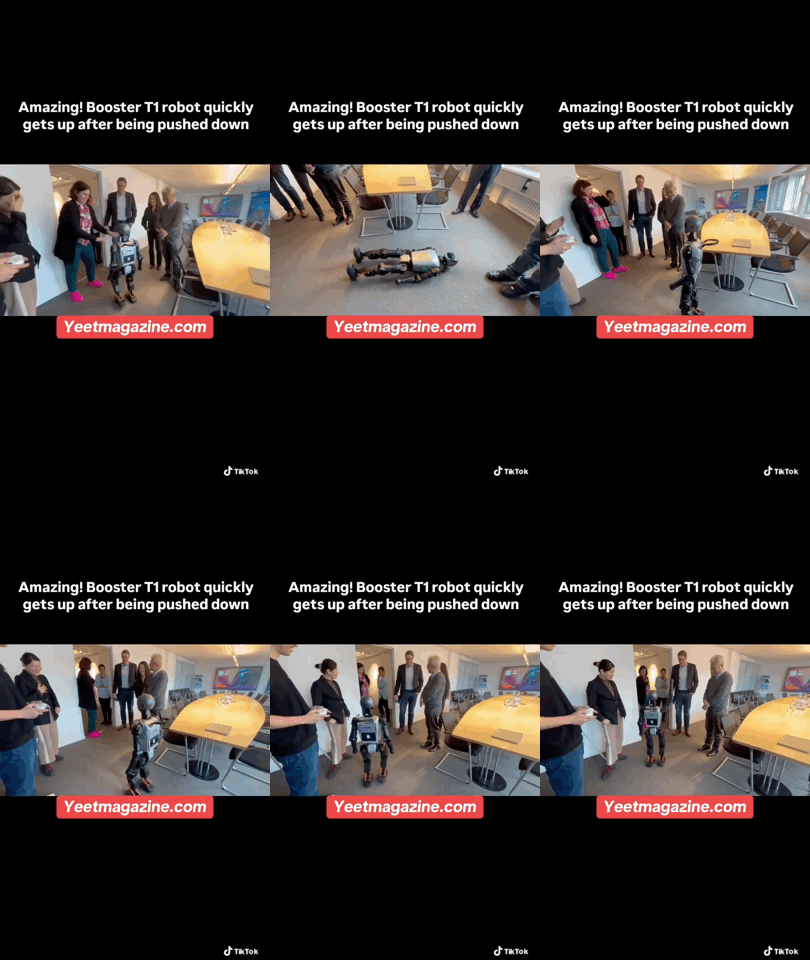
Can AI-powered robots stay upright and recover from falls faster than humans? Yes. A viral video showcases a self-balancing robot that gets knocked down and springs back up in seconds using real-time sensor data and machine learning algorithms. This isn't sci-fi—it's a breakthrough in robotic autonomy powered by AI decision-making. The robot's ability to adapt to unpredictable impacts suggests we're entering an era where machines can handle chaotic environments humans find dangerous. This tech could revolutionize disaster response, healthcare automation, and factory efficiency while forcing us to rethink workforce disruption.
The viral moment isn't just about watching a robot get up. It's about witnessing algorithms in action. Self-balancing systems rely on continuous data feedback from gyroscopes, accelerometers, and pressure sensors—collecting and processing information hundreds of times per second.
Here's what's actually happening under the hood:
Real-Time Sensor Networks – The robot constantly monitors its position, velocity, and orientation. Every millisecond, it's making micro-adjustments to stay stable.
Machine Learning Models – AI trains on thousands of fall scenarios to predict the best recovery strategy. It learns patterns humans never could identify manually.
Adaptive Motor Control – Actuators receive instant commands from the AI brain. There's no delay between detection and response.
Self-Righting Algorithms – Unlike older robots that needed human intervention, this system automatically sequences movements to regain balance or stand upright.
The implications are massive. A robot that can't be knocked down is a robot that can work unsupervised in chaotic environments.
This changes where automation actually works:
Disaster Response & Emergency Services – Robots entering collapsed buildings or flooded areas need to navigate unpredictable terrain. Self-balancing AI means they can push through obstacles and recover from impacts autonomously. No operator needed on-site.
Healthcare & Elderly Care – These robots could assist people without becoming liabilities themselves. A robot that falls and self-corrects won't injure the patient it's helping. Hospitals are already testing autonomous machines in patient transport and disinfection.
Manufacturing & Logistics – Factory floors are chaotic. Moving parts, uneven surfaces, and collisions happen constantly. Self-balancing robots reduce downtime from damage and maintenance. The efficiency gains compound over months.
Space Exploration – Mars rovers need to handle terrain humans can't predict. AI-powered balance systems could enable more ambitious exploration without constant remote control from Earth.
The safety question isn't theoretical anymore. Robots this capable demand regulation that doesn't exist yet. Here's what worries experts:
Autonomous Decision-Making in High-Risk Scenarios – If a robot can act independently, who's liable when something goes wrong? Current AI can't explain its decisions in real-time.
Job Displacement at Scale – Self-balancing robots work in conditions humans previously had to fill. Manufacturing jobs, warehouse roles, construction positions—these are next.
AI Training Data Bias – If the machine learning model trains on limited scenarios, it might fail catastrophically in novel situations. We've seen this with autonomous vehicles.
Cybersecurity Vulnerabilities – Robots communicating over networks can be hacked. A compromised self-balancing algorithm in a dangerous environment could cause harm at scale.
Experts argue we need AI safety standards before deployment, not after. The EU's AI Act is attempting this, but enforcement is still messy.
Is this the robot future everyone imagined? Sort of. We're getting capable machines faster than we're preparing the workforce and regulations for them.
Quick hits on what people actually want to know:
Q: Could this robot replace my job?
A: Depends on your job. If it involves unpredictable physical environments and tasks that don't require emotional labor, probably yes—within 5-10 years. Self-driving trucks, warehouse automation, and facility maintenance are all actively being disrupted.
Q: How much does a robot like this cost?
A: Current prototypes run $50K-$500K+ depending on capabilities. But economies of scale are real. Consumer-grade robotics follow the smartphone trajectory—expensive now, affordable in five years.
Q: Is the AI actually "smart" or just running pre-programmed moves?
A: Modern versions use reinforcement learning, which means the robot genuinely learns from novel situations. It's not just replaying scripts. That's what makes it dangerous and powerful.
Q: Will governments regulate this?
A: Slowly. China is moving fast on robotics deployment with minimal restrictions. The US and EU are debating frameworks while the technology advances. History suggests regulation lags innovation by years.
Q: Could bad actors weaponize this?
A: Military applications are already being explored. Self-balancing robots in hostile terrain are attractive for defense. This is why AI safety in robotics is a national security issue.
Q: What's the next breakthrough after self-balancing?
A: Computer vision combined with predictive algorithms. Robots that see hazards coming and navigate around them proactively, not just react to impacts.
The real story here isn't that a robot can get up—it's that algorithms can now make machines resilient in ways evolution took millions of years to teach humans. That speed of development is what should actually make us pay attention. Read more about how automation is reshaping job markets and machine learning's real-world impact to understand the broader context.
What do you think? Is this the future you want? Drop it in the comments.