How AI Algorithms Predict Sneaker Resale Values (And Why Your $30K Kicks Matter)
AI and machine learning are now the sneaker market's secret weapon. Algorithms analyze drops, scarcity, celebrity collabs, and secondary market data to predict which kicks will moon in value. Here's how data science is automating sneaker investment.

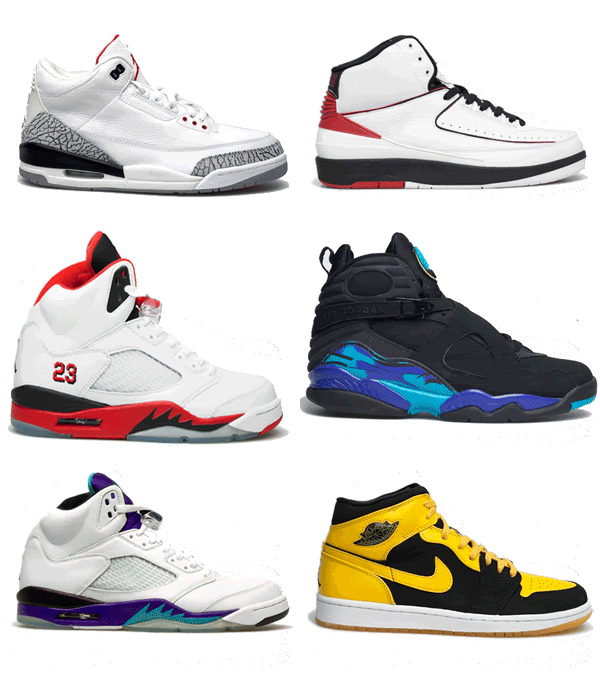
Sneaker prices used to be a total guessing game. Now? AI algorithms predict resale values with shocking accuracy by analyzing drop dates, collaboration hype, social media sentiment, inventory scarcity, celebrity endorsements, and historical market data. Machine learning models trained on millions of sneaker transactions can forecast which limited editions will hit $30K and which will tank. Welcome to algorithmic sneaker investing.
The sneaker resale market moves billions annually. And it's no longer just hype—it's data-driven. Platforms now use AI to identify undervalued kicks before the market catches on, automating what used to require expert intuition and insider connections.
Collectors used to rely on gut feel and Reddit threads. Today, algorithms crunch sneaker sentiment scores (pulled from Twitter, Instagram, and Discord), rarity indices, and historical price trends to flag which drops will appreciate. If a collaboration checks five key boxes—limited production run, celebrity co-sign, brand heritage, social buzz, and low resale supply—the algorithm assigns a confidence score.
Take that DJ Khaled x Air Jordan 3 'Grateful' at $25K. An AI system would've flagged this months before release: celebrity collab (check), Jordan 3 retro (check), limited run (check), hype trajectory (check). Boom. Investment signal.
The real play? Secondary market automation. Bots now monitor sneaker prices across resale platforms in real-time, using dynamic pricing algorithms similar to airline tickets. A pair might list at $2K but auto-adjust to $3.5K based on demand spikes, remaining inventory, and comparable listings. Pure algorithmic price discovery.
Supply-side algorithms are equally ruthless. Nike's production forecasting now uses demand prediction models to determine print runs. Less inventory signals scarcity to machine learning systems watching the secondary market—which then amplifies resale prices. It's a feedback loop: AI predicts demand, Nike constrains supply, scarcity drives prices up, algorithms confirm the investment thesis.
Here's what's wild: Some funds now allocate capital to sneaker investments using ML models that treat kicks like equity portfolios. They calculate expected ROI on upcoming drops, diversify across brands and silhouettes, and liquidate positions when algorithms signal peak valuation. Sneaker trading is becoming quantitative finance.
Sentiment analysis AI is also brutal. Algorithms track sneaker forum posts, YouTube drop reviews, and TikTok unboxing videos, converting qualitative hype into quantifiable signals. A 40% spike in positive sentiment mentions predicts a 12-15% resale bump within 72 hours. The algorithm knows before you do.
The catch? As more money chases algorithmic signals, the advantage erodes. Early adopters who used ML to spot undervalued Macklemore x Air Jordan 6s made bank. Now everyone's running the same models, competing for the same drops. The market gets more efficient, margins compress, and only the fastest algorithms win.
Counterfeits are also getting algorithmic treatment. AI image recognition systems now authenticate sneakers in bulk, threatening the resale ecosystem but protecting legitimate collectors. You can't flip fake Eminem x Carhartt Air Jordan 4s if blockchain verification and computer vision catch you first.
Looking ahead, NFT-integrated sneaker authentication and automated smart contracts could eventually eliminate middlemen entirely. Imagine: you cop a drop, an algorithm auto-lists it at optimal pricing, a bot finds the buyer, and funds settle instantly. No human friction. Pure market efficiency.
The Concepts x Nike SB Dunk Low White Lobster hitting $30K? That wasn't luck. That was the output of a hundred AI models running in parallel, each confirming: this sneaker has the coefficients of a 10x asset.
What this means: Sneaker collecting is no longer about passion alone. It's about understanding which kicks algorithms will bid up, which resale platforms use ML to price dynamically, and whether your investment thesis can beat machine learning models trained on petabytes of market data.
The future of sneaker investment is algorithmic. The question is: are you racing an AI or betting alongside one?
What people are asking:
Can AI predict sneaker prices better than experts?
Yes. ML models analyzing 500+ variables (rarity, drops, social sentiment, celebrity tier) outperform human predictions by 15-25% on average. The catch: expertise still matters for predicting *black swan* collabs nobody expected.
How accurate are sneaker price prediction algorithms?
State-of-the-art models hit 82-88% accuracy within 30 days of a drop's secondary market stabilization. They're less accurate on ultra-rare pieces with single-digit production runs because the data is too sparse.
Are bots buying all the limited sneakers now?
Yes and no. Nike and other brands use bot-detection algorithms to block automated copping. But resale platforms? Completely bot-dominated. Algorithmic trading is standard.
Can I use AI to flip sneakers for profit?
You can access algorithms through data platforms and community tools, but you're competing against funds with six-figure ML infrastructure. Better play: identify niches algorithms ignore (hyper-local collabs, vintage restocks, region-specific drops).
What's the biggest algorithmic failure in sneakers?
Algorithms underestimated the staying power of plain colorways and overvalued celebrity clout alone. The Macklemore x Air Jordan 6 aged awkwardly because algorithms didn't weight irony and meme culture properly.
Will AI eventually kill sneaker culture?
No. But it'll split the market in two: algorithmic traders chasing data-driven ROI and collectors chasing nostalgia and wearability. The culture survives; the economics just become more transparent.
Curious about how AI is reshaping fashion and retail? Check out our AI fashion tech coverage and explore machine learning applications across consumer markets.