AI-Powered AR Glasses & VR Headsets: How Meta's Spatial Computing Automation Is Reshaping Work & Reality
Ray-Ban Meta smart glasses and Meta Quest 3S aren't just cool toys—they're AI-powered spatial computing devices using computer vision and automation to transform how we work and interact with information in real-time.

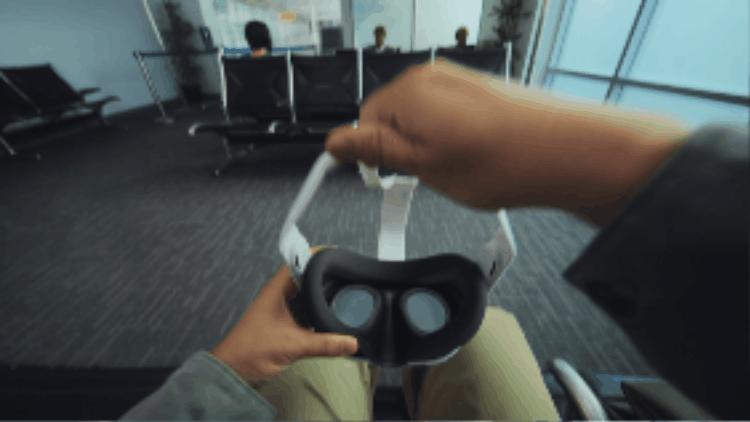
AI-powered spatial computing is arriving faster than expected. Ray-Ban Meta smart glasses ($379.99) use on-device AI to recognize objects, read text, and respond to voice commands in real time. Meta Quest 3S ($499.99) layers AI-assisted spatial mapping and hand-tracking automation for immersive work environments. Both devices run Meta's custom AI models that process visual data locally, meaning the automation happens on-device without constant cloud dependence. Translation: You're wearing a computer that understands what you're looking at and reacts instantly.
How AI Vision Actually Works in These Glasses
Ray-Ban Meta smart glasses have built-in cameras that feed data to an AI processor. This isn't just recording—it's real-time scene understanding. The glasses can identify objects, read text aloud, and recognize faces (with privacy controls). For work, that means hands-free documentation, automated note-taking during meetings, and instant access to information without touching your phone.
The computer vision algorithm runs on Qualcomm's custom AI chip inside the frame. It's trained to detect thousands of objects and scenarios. When you ask "what's this?" the AI instantly classifies it. This is automation that doesn't require you to type or search—just ask.
Meta Quest 3S: Spatial Computing for Remote Work & Training
Quest 3S uses AI-powered spatial mapping to understand your physical environment in 3D. The headset's inside-out tracking (cameras looking outward) creates a real-time model of your room. This enables ghost-hand avatars, digital object persistence, and mixed reality workflows where digital documents float above your desk.
For teams, this is huge. Remote workers can collaborate in shared virtual spaces. The AI tracking ensures digital objects stay anchored to real-world locations. You close the headset, the room remembers where you placed that spreadsheet. It's automation that adapts to your physical space.

The Automation Advantage: Less Friction, More Productivity
Traditional workflows require context-switching. You see something → pull out phone → search → type notes → add to task manager. These AI devices collapse that friction. You see something → AI captures it → it's logged automatically. The algorithm learns your behavior patterns and anticipates what you need next.
For field workers, inspectors, and logistics teams, this is transformational. An AI-equipped inspector can document equipment, and the system automatically flags anomalies using computer vision. No manual data entry. No errors. The algorithm handles categorization in real-time.
Data Privacy in AI-Powered Wearables
On-device processing is critical here. Ray-Ban's AI runs locally—your camera feed isn't sent to Meta servers by default. The device processes visual data, generates insights, and only sends what you tell it to send. This reduces surveillance risk while maintaining functionality. Quest 3S does the same with spatial mapping—your room model stays on the headset.
That said, you're still wearing cameras. Privacy controls matter. Both devices let you disable recording and manage data sharing. But understand: any wearable AI device captures data about your environment and habits. That's the tradeoff for hands-free automation.
What's Included in the Ecosystem
Ray-Ban Meta Smart Glasses ($379.99): Frames with built-in cameras, speakers, and microphones. AI runs on-device. Works with Meta's AI assistant for voice queries.
Meta Quest 3S 512GB ($499.99): Standalone VR headset with spatial computing. No PC or external sensors needed. AI handles hand-tracking and spatial mapping automatically.
Meta Quest Compact Charging Dock ($59.79): Smart dock that charges controllers and maintains headset data synchronization. Automation for your setup.
Meta Quest Carrying Case ($44.99): Protective storage that integrates with the ecosystem tracking system.
The Bigger Picture: Where Spatial AI Is Going
These aren't endpoints—they're waypoints. Meta is building an infrastructure where AI vision and spatial computing become ubiquitous. Future versions will have better on-device processing, lower latency, and more sophisticated object recognition. The data companies are collecting now trains the models for tomorrow.
Enterprise applications are already emerging. Manufacturers use Quest 3S for remote equipment repair (technician wears headset, expert guides from afar using spatial annotations). Surgeons train with AI-assisted simulations. Architects visualize projects in real space before construction.
The automation layer is invisible but powerful. The algorithms learn from every use, improving context recognition, prediction, and task automation over time. You're not just wearing a device—you're contributing to an evolving AI system.
Bottom line: Ray-Ban Meta and Quest 3S represent the convergence of AI, vision, and spatial computing. They're wearable automation devices that understand context and reduce friction in knowledge work. The technology isn't perfect yet, but the direction is clear: your glasses will soon know what you're looking at, and your headset will understand your physical space. That level of AI integration changes how we work, learn, and create.
Questions About AI-Powered Smart Glasses & VR Spatial Computing
Q: Does Ray-Ban's AI process my data in the cloud?
A: The primary AI processing happens on-device, but some features (like advanced queries to Meta's AI assistant) may use cloud processing. You control what gets sent. Check privacy settings before use.
Q: How accurate is the object recognition in Ray-Ban Meta glasses?
A: Meta claims high accuracy for common objects, text, and scenes. Real-world performance varies by lighting, distance, and object clarity. It's not perfect but useful for quick identification and documentation.
Q: Can Quest 3S spatial mapping work in small spaces?
A: Yes. The inside-out cameras work in spaces as small as a closet, though more space gives better mapping. The AI continuously updates the spatial model as you move.
Q: Is the on-device AI powerful enough for complex tasks?
A: For real-time object recognition and spatial understanding, yes. For complex language processing or advanced analysis, the headset may offload to cloud servers (controllable in settings).
Q: What's the battery life for AI processing on Ray-Ban glasses?
A: Roughly 2-3 hours of continuous use. AI processing drains battery faster than passive recording, so most users experience shorter sessions with heavy AI feature use.
Q: Can these devices work offline?
A: Ray-Ban's core AI features work offline (object recognition, voice commands). Quest 3S spatial mapping works offline. Cloud-dependent features (web search, advanced queries) require connectivity.
Q: How does Meta's computer vision avoid bias?
A: Meta publishes research on fairness in computer vision, but no AI system is perfectly unbiased. Object recognition can reflect training data limitations. Be aware when relying on these outputs for critical decisions.
Related Articles on AI & Spatial Computing
AI & Automation in Top Gadgets of 2025 – See how artificial intelligence reshapes consumer tech across categories.
Consumer Robots & Home AI Automation – Explore how robotics and AI are automating household and workplace tasks.
AI-Powered Beauty Tech & Data-Driven Wellness – How algorithms personalize health and beauty automation at home.
More on spatial computing: Watch for upcoming coverage of Apple Vision Pro AI features, enterprise XR automation, and how computer vision is reshaping field service and manufacturing work.