OpenAI Sora Is Automating Video Creation: How AI Video Generation Will Reshape the Future of Work and Creative Industries
OpenAI Sora Is Automating Video Creation: How AI Video Generation Will Reshape the Future of Work and Creative Industries
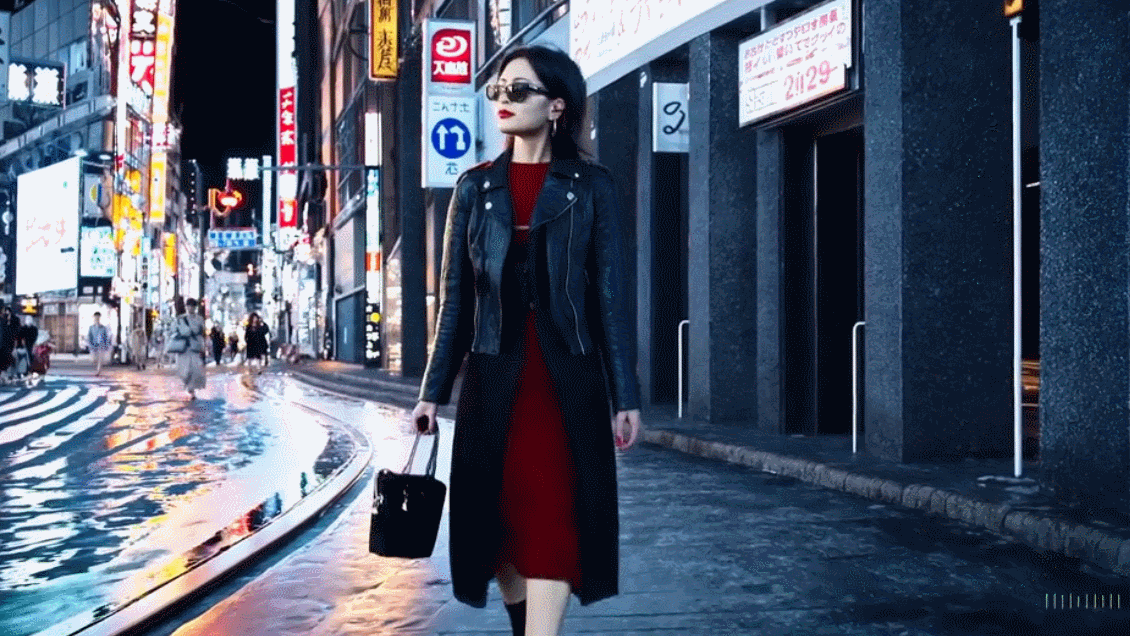
The world of video production is undergoing a seismic shift. OpenAI Sora, a groundbreaking AI video generation model, is automating the creation of high-quality videos from simple text prompts. This technology promises to democratize filmmaking, but it also raises urgent questions about the future of work in creative fields. As video automation becomes mainstream, professionals must adapt or risk obsolescence.
Imagine describing a scene—"a neon-lit cyberpunk city at dusk, with flying cars and holographic billboards"—and within minutes, Sora generates a photorealistic video. This is not science fiction. OpenAI Sora leverages advanced diffusion models and transformer architectures to understand complex scenes, physics, and motion. The implications for AI content creation are staggering: marketing teams can produce ads instantly, indie filmmakers can visualize stories without budgets, and educators can create immersive lessons.
But with great power comes great disruption. Automated video production threatens traditional roles like videographers, editors, and animators. Yet, it also opens new opportunities for AI filmmaking specialists who can prompt, curate, and refine machine-generated content. The key is to embrace creative automation as a tool, not a replacement.
To understand the impact, we must explore five critical questions about OpenAI Sora and AI video generation automation.
How Does OpenAI Sora Automate Video Generation and What Makes It Different?
OpenAI Sora is not just another text-to-video tool. Unlike earlier models that produced short, low-resolution clips, Sora generates up to 60 seconds of coherent, high-definition video with consistent characters and environments. It uses a video automation pipeline that combines a diffusion model with a transformer to handle temporal dynamics. This allows it to simulate realistic motion, lighting, and even camera angles. For AI content creation, this means you can generate complex narratives without manual editing.

The underlying architecture is a breakthrough. Sora learns from millions of videos, understanding how objects interact, how light behaves, and how scenes transition. This AI filmmaking capability reduces the need for expensive equipment and post-production. However, it also challenges the notion of authorship—who owns a video generated by an AI?
Will OpenAI Sora Replace Human Video Editors and Filmmakers?
The fear of job displacement is real. Automated video production can handle tasks that once required hours of manual work: cutting, color grading, adding effects. But OpenAI Sora is not a complete replacement. Human creativity is still needed for ideation, emotional nuance, and ethical oversight. The future of work in video will likely involve collaboration between humans and AI, where professionals become prompt engineers and quality controllers.
For example, a marketing agency might use Sora to generate 50 variations of a product demo, then a human editor selects the best and adds a brand voiceover. This creative automation speeds up production but doesn't eliminate the need for strategic thinking. In fact, demand for AI tools 2025 specialists is rising, with new job titles like "AI Video Curator" and "Generative Media Director."
Yet, entry-level roles like junior editors may shrink. The key is upskilling. Professionals who learn to leverage video automation will thrive, while those who resist may struggle. The AI content creation revolution is not a death knell but a transformation.
What Are the Ethical and Legal Implications of AI Video Generation Automation?
With OpenAI Sora, anyone can create realistic videos of events that never happened. This raises deepfakes concerns, misinformation risks, and copyright issues. AI video generation can be used to impersonate public figures, fabricate news, or violate intellectual property. The future of work must include robust ethical guidelines and watermarking technologies.
OpenAI has implemented safety measures, such as content filters and usage restrictions, but the cat is out of the bag. Video automation tools are becoming accessible to bad actors. Society needs new laws to govern AI filmmaking and protect against malicious use. Meanwhile, creators must be transparent about AI-generated content to maintain trust.
On the positive side, creative automation can empower marginalized voices. A filmmaker in a developing country can produce Hollywood-quality videos without a studio. The ethical challenge is to balance innovation with responsibility.
How Can Businesses and Creators Leverage OpenAI Sora for Competitive Advantage?
Early adopters of OpenAI Sora are already gaining an edge. Marketing teams use it to A/B test ad creatives in minutes. E-commerce brands generate product videos at scale. Educators create interactive lessons with AI content creation. The video automation capability reduces costs and time-to-market dramatically.
For instance, a travel agency can input "aerial view of a tropical beach resort at sunset" and get a promotional video instantly. This AI filmmaking approach allows small businesses to compete with big budgets. However, success requires strategic integration: using Sora as part of a broader creative automation workflow that includes human oversight and brand consistency.
Internal link: AI Content Creation Tools 2025 — Discover more tools that complement Sora.
Companies that ignore AI video generation risk falling behind. The future of work is about agility. Those who embrace automated video production will unlock new revenue streams and efficiencies.
What Skills Will Be Most Valuable in the Age of AI Video Generation Automation?
As OpenAI Sora automates technical tasks, soft skills become paramount. Creativity, storytelling, critical thinking, and ethical judgment are irreplaceable. AI content creation requires humans to define the vision, set parameters, and evaluate outputs. The video automation specialist of tomorrow will be part artist, part data scientist.
Learning to prompt effectively is a new art form. Crafting detailed, nuanced prompts for AI filmmaking yields better results. Understanding the limitations of creative automation—such as handling complex physics or subtle emotions—is crucial. Additionally, skills in AI ethics, data privacy, and digital literacy will be in high demand.
Internal link: Upskilling for the AI Era — A guide to future-proof your career.
Educational institutions are already updating curricula to include AI tools 2025. Workshops on automated video production are popping up. The message is clear: adapt or be left behind. The future of work belongs to lifelong learners who can dance with machines.
Internal link: AI and Creativity: Finding the Balance — Explore how to maintain human touch in automated workflows.
In conclusion, OpenAI Sora is a watershed moment for AI video generation automation. It offers unprecedented power to create, but also demands responsibility. The future of work will be shaped by how we integrate video automation into our lives. By embracing creative automation and upskilling, we can harness this technology for good.
Internal link: Automation Ethics Guide — Navigate the moral landscape of AI.
Internal link: AI Video Production Case Studies — Real-world examples of Sora in action.
Internal link: Future of Work Report 2025 — Comprehensive analysis of job trends.
Internal link: Creative Automation Tools — A curated list of AI tools for creators.
Avery Thompson is a staff writer at YEET Magazine who covers AI privacy, security, and data rights.