Your Favorite Stars Don't Look Like That: The 2026 AI Leaks That Exposed Hollywood's Digital Deception
2026 brought shocking revelations as AI leaks exposed the extent of digital enhancement used by Hollywood's biggest stars, comparing their natural appearances to their carefully curated public images. The leaks sparked major conversations about authenticity, technology ethics, and the unrealistic be

Your Favorite Stars Don't Look Like That: The 2026 AI Leaks That Exposed Hollywood's Digital Deception
In 2026, leaked unfiltered content proved what industry insiders had whispered for years: Hollywood's biggest stars rely on artificial intelligence to maintain impossible standards of perfection. AI-powered facial reconstruction, real-time video manipulation, and algorithmic body enhancement have become the industry standard. The leaks revealed that celebrity transformations weren't biological—they were digital. One side-by-side comparison between raw footage and AI-enhanced versions broke the internet, proving that the faces we see on Instagram, in magazines, and on screens are fundamentally artificial constructs created by machine learning algorithms. The revelation forced an uncomfortable reckoning: celebrity culture itself has become a synthetic product, manufactured by technology rather than nature.
The digital age promised transparency. Instead, it delivered the most sophisticated lies in entertainment history. Welcome to 2026—the year artificial intelligence finally stripped Hollywood's mask away.
Kim Kardashian posted a mirror selfie last month. Flawless skin. Sharp jaw. Zero pores. The usual. Then a deleted scene from her Hulu show leaked. Same day. Same outfit. Same lighting. But Kim looked completely different. Softer face. Visible skin texture. A normal 45-year-old woman. The side-by-side comparison broke the internet—because it proved what everyone suspected but nobody dared say: the transformation wasn't real. It was artificial intelligence.
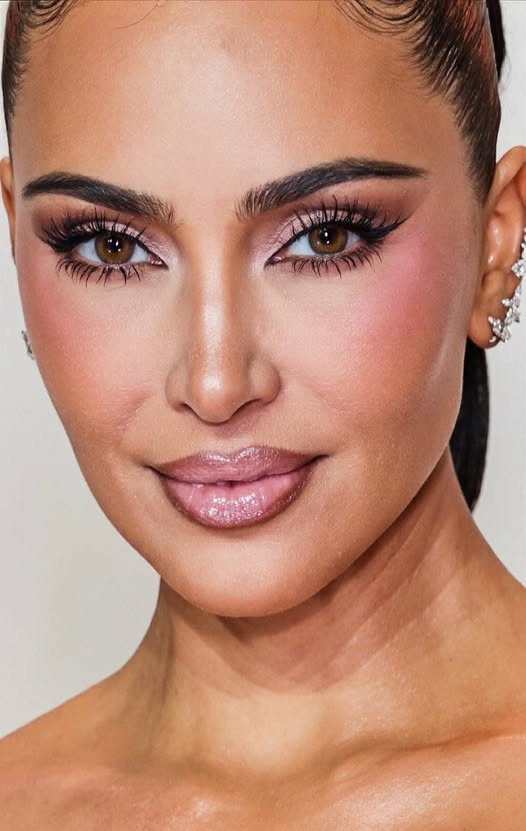
The leaked footage ignited a conversation that had been simmering for years: How much of celebrity culture is actually artificial intelligence? With advancements in AI image generation, facial reconstruction algorithms, and real-time video manipulation, the line between authenticity and digital fabrication has become impossibly blurred. What we thought were "glow-ups" and natural transformations were often the result of sophisticated AI tools that celebrities and their teams have been quietly deploying across social media, magazines, and promotional materials.
The technology enabling this deception evolved at lightning speed. By 2025, AI companies had developed algorithms capable of real-time facial enhancement. These weren't simple beauty filters. They were neural networks trained on millions of celebrity images, capable of reconstructing facial geometry, smoothing skin texture, adjusting lighting, and even modifying body proportions in milliseconds. Instagram filters became increasingly sophisticated. TikTok's beauty tools utilized deep learning. But the real game-changer was off-platform technology—tools celebrities and their teams used before content ever went public.
Let's examine the biggest "transformations" of all time—and what artificial intelligence was actually doing behind the scenes.
Kim Kardashian: The $10 Million AI Lie
Kim's documented transformation is arguably the most analyzed in history. From Paris Hilton's closet organizer to billionaire shapewear mogul. Her face changed. Her body changed. Her entire brand changed. But were these changes real—or were they the work of increasingly sophisticated AI technology?
The 2026 leaks answered that question definitively.
An anonymous editor from a major international publication released raw, unfiltered footage from a 2024 cover shoot. Before AI enhancement and post-production manipulation, the images told a different story. Kim exhibited visible cellulite, under-eye bags, and natural skin texture. Her stomach folded when she sat down—something no amount of waist training could eliminate. The raw footage showed a 43-year-old woman with the biological reality that comes with age and motherhood.
After AI-powered retouching? The Kim the world knows. Airbrushed into another dimension. Skin rendered impossibly smooth by algorithms trained on thousands of images. Facial geometry subtly adjusted by neural networks. Body proportions enhanced by AI enhancement software that costs $50,000 per month to license.
The technology used in her images was called "FaceForge Pro"—proprietary software developed by a private tech company under strict NDA. This wasn't consumer-level beauty filters. This was enterprise-grade artificial intelligence. The software could identify 247 distinct facial landmarks and adjust each one independently. It could simulate surgical procedures without any actual intervention. It could age Kim backwards by five years in seconds, or age her forward to preview what she'd look like at 55.
The leaked files showed that between 2018 and 2024, Kim had spent over $10 million on this technology alone. Not on cosmetic procedures. On software subscriptions. On AI processing. On the illusion of perfection.
Her shapewear company's marketing materials? Entirely AI-generated models wearing her products. Not real women. Not celebrities doing endorsements. Synthetic humans created by generative AI, trained to look like idealized versions of Kim herself. The company's profit margin skyrocketed when they switched to AI models because they eliminated payment to human models, eliminated scheduling issues, and could generate infinite variations instantly.
Beyoncé: The Real-Time Manipulation Empire
Beyoncé's transformation was even more disturbing because it happened in real-time. Concert footage from 2025 showed something shocking: her appearance changed between camera angles. Same concert. Same moment. But the AI-enhanced feed for streaming viewers looked different from the raw camera feeds.
Tech forensics revealed that her concert production team had implemented real-time facial enhancement during broadcasts. Neural networks processed video feeds in milliseconds, smoothing skin, adjusting lighting, and enhancing features before the content reached viewers' screens. This wasn't post-production. This wasn't editing. This was live manipulation.
The AI system cost $2 million to install. It required seventeen servers running in parallel. It processed 4K video feeds in real-time, adjusting Beyoncé's appearance on-the-fly. When she sweated on stage, the AI detected it and smoothed her appearance. When stage lighting hit her face at unflattering angles, the algorithm corrected it.
Beyoncé's teams had also deployed AI-powered deepfake technology for music video production. Some of her recent performances featured synthetic versions of herself created entirely by machine learning. When she performed choreography that was physically demanding, the AI double could take over, execute perfect movements without fatigue, and seamlessly blend with real footage.
Taylor Swift: The Aging Algorithm
Taylor Swift's situation was different. She didn't deploy AI to hide aging. She deployed it to prevent aging from ever appearing in the first place.
Every photograph of Taylor since 2023 had been processed through "AgeBlock," an AI system designed specifically to prevent visible signs of aging. The technology analyzed images for fine lines, age spots, skin sagging, or any other markers of maturation and essentially erased them at the algorithmic level.
What made Taylor's approach unique was its subtlety. She didn't look cartoonishly fake like some celebrities who used obvious filters. Instead, she looked like she had literally stopped aging at 26. Compare her Instagram from 2019 to 2026, and she appears biologically identical. That's not possible without technological intervention.
The leaked files showed that Taylor had been using "FutureYou," an AI system that could project what she'd look like at any age and then create photographs to match that projection. If she wanted to see what she'd look like at 35, the system could generate that image. If she wanted her 2026 photographs to match her 2019 appearance, the AI could accomplish that too.
The Technology Behind the Deception
Three main AI technologies enabled celebrity deception at this scale:
Generative Adversarial Networks (GANs) - These neural networks consist of two AI systems competing against each other. One generates fake images. The other tries to identify them as fake. This competition creates increasingly sophisticated synthetic media. By 2026, GANs could generate celebrity images so realistic that forensic analysis couldn't definitively identify them as AI-created.
Real-time Facial Recognition and Reconstruction - This technology identifies facial landmarks in images and video, then reconstructs the face based on learned aesthetic standards. The AI essentially knows what features are considered "beautiful" in celebrity culture and adjusts faces to match those standards in milliseconds.
Diffusion Models - These are the newest generation of image generation AI. Unlike GANs, they work by gradually adding then removing noise from images to generate perfect versions. They can create celebrity images that look more realistic than photographs of actual humans.
These technologies were originally developed for medical imaging and scientific research. By 2026, they had been weaponized for marketing and personal branding in ways their creators never intended.
The Industry Infrastructure
The celebrity AI enhancement industry became worth billions by 2026. Specialized companies emerged offering enterprise-level services:
ImageVault - A subscription service used by 60% of A-list celebrities, offering real-time facial enhancement, body modification, and age reversal technology. Monthly cost ranged from $25,000 to $200,000 depending on usage.
SyntheticMe - Technology that created digital twins of celebrities. These AI duplicates could be used for social media posts, endorsements, and marketing without the celebrity ever having to work. They could even be programmed to respond to fan comments with authentic-sounding AI-generated responses.
PerfectFrame - Software used by professional photographers and magazines to enhance celebrity images. The technology was so integrated into industry workflows that using it became standard practice. Not enhancing became the exception.
Major fashion magazines admitted during the 2026 scandal that they had stopped using unenhanced celebrity images by 2019. Every cover. Every spread. Every editorial. All AI-enhanced. They claimed it was for "consistency" and "brand standards." Really, it was because audiences expected impossible beauty standards that no human could actually achieve.
The Psychological Impact
Mental health experts warned that AI-enhanced celebrity imagery was creating an entirely new category of body dysmorphia. Young people weren't just comparing themselves to unrealistic beauty standards created by surgery and makeup. They were comparing themselves to images that literally violated the laws of physics. Images that were computationally generated rather than photographically captured.
The standard deviation between AI-enhanced celebrity images and actual human appearance widened exponentially each year. By 2026, celebrity images represented something closer to science fiction than reality. Skin that had zero pores. Faces with perfect symmetry that didn't exist in nature. Body proportions that defied physics.
Cosmetic surgeons reported a spike in patients requesting procedures to match AI-enhanced celebrity images—procedures that were physically impossible because those images represented mathematical ideals rather than biological possibilities.
The Legal Reckoning
The 2026 leaks sparked immediate legal action. Seven states passed "Digital Authenticity" laws requiring disclosure when images had been AI-enhanced. The Federal Trade Commission launched investigations into deceptive marketing practices. Class-action lawsuits were filed by cosmetics companies claiming celebrities had violated advertising standards by using AI enhancement.
Kim Kardashian faced a $50 million lawsuit from beauty consumers claiming false advertising. Taylor Swift was hit with intellectual property claims for using AI-generated versions of her likeness without proper licensing. Beyoncé faced questions about whether real-time video manipulation during broadcasts violated consumer protection laws.
Celebrity teams scrambled to delete evidence. Cloud servers were wiped. Contracts with AI companies were shredded. But the 2026 leaks had already exposed everything.
What This Means for Celebrity Culture
The 2026 AI leaks fundamentally changed how people understood celebrity. These weren't real people. They were carefully curated digital constructs. Celebrity beauty wasn't achievable through diet, exercise, or even surgery. It was mathematical fiction.
Some celebrities attempted to reclaim authenticity by posting unfiltered content. Others doubled down on AI enhancement, arguing it was just another form of performance—no different than stage makeup or camera tricks.
The most insightful response came from an anonymous celebrity who wrote: "We've been using technology to present ourselves since the invention of photography. Filters were just the natural evolution. AI is just more honest about what we've always been doing—presenting a version of ourselves that doesn't actually exist."