Silicon Valley Is Repeating Rome's Collapse — And AI Is the Barbarians
Silicon Valley Is Repeating Rome's Collapse — And AI Is the Barbarians
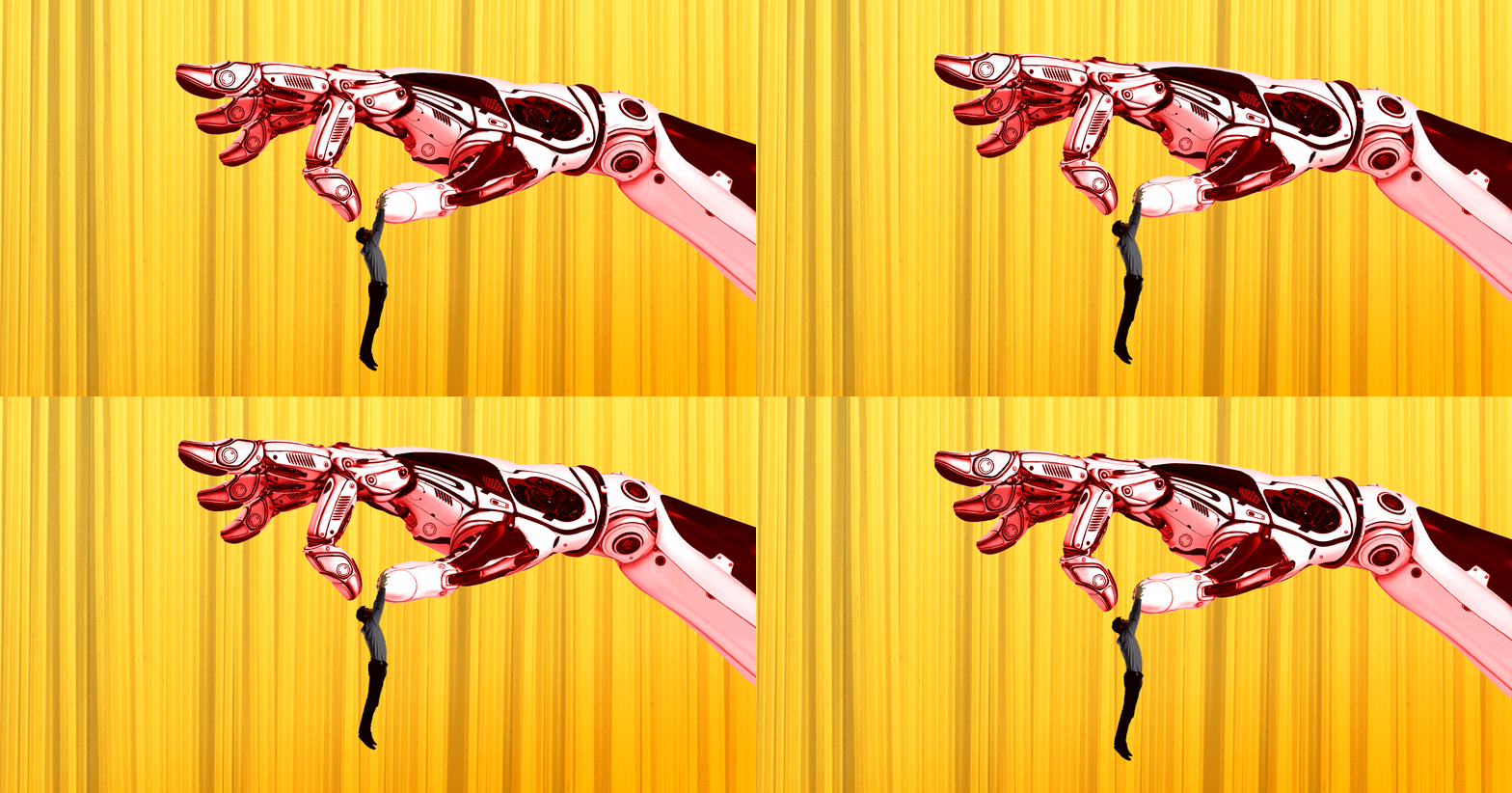
Here's the thing: tech layoffs and AI automation aren't just business cycles. They're a replay of the exact pattern that brought down the Roman Empire. You've got a bloated center of power, a ruling class making increasingly desperate decisions, and a new technology (in Rome's case, barbarian military innovation; in ours, artificial intelligence) that the old guard can't control. And just like the fall of Rome took centuries but happened in accelerating waves, Silicon Valley's collapse is happening faster than anyone admits.
The parallels are uncanny. Rome spent generations building an empire. Then it got comfortable. The military stopped innovating. The bureaucracy became self-serving. Leaders stopped thinking about the empire and started thinking about keeping their own power. By the time barbarians showed up with better tactics, Rome was already hollow inside.
Tech is following that script beat-for-beat. Meta, Amazon, Google—these companies spent 15 years hiring thousands of people, building bloated organizations, and optimizing for growth instead of resilience. Then AI arrived. Suddenly, they realized they could do with 10,000 people what used to take 50,000. The mass layoffs that followed weren't strategic pivots. They were panic moves. A recognition that the old system was already dying.
The terrifying part? Just like Rome couldn't stop the barbarians once they started crossing the borders, tech companies can't stop the AI wave. They built it. They unleashed it. And now they're discovering that AI automation in the workplace doesn't care about quarterly earnings or stock buybacks. It just optimizes everything, including eliminating its creators' jobs.
Why Did Rome's Ruling Class Miss the Signs?
Rome didn't collapse overnight. It took about 300 years from the empire's height to the final sack of the city. But most historians agree the decline was visible from around year 100—if you were paying attention. The problem? The people in power were never paying attention. They were too busy consolidating their wealth, fighting each other for status, and pretending the system was fine.
Sound familiar? Tech executives spent years dismissing AI risks while building AI. They told workers their jobs were safe. They promised that technology always creates new opportunities (it does, but not for the people you displaced). They optimized for metrics instead of meaning. And when the inflection point came—when AI suddenly became good enough to replace actual human knowledge work—they flipped the switch with a memo on a Monday morning.
The Roman elite had the same blindspot. They believed their system was eternal. They believed the people they ruled needed them. They believed that controlling information meant controlling reality. (Sound like any tech platform you know?) And when that belief got tested, it collapsed catastrophically.
What Happens to Workers When Empires Fall?
Here's where it gets dark. During Rome's collapse, regular people didn't lose their jobs instantly. That would have been mercy. Instead, they experienced what historians call "long decline." Salaries dropped. Benefits vanished. The safety net that held civilization together got shredded. People became desperate. Communities fragmented. The skills that made you valuable yesterday became worthless overnight.
Tech workers in 2026 are living that exact timeline right now. When Meta laid off 21% of its workforce (that's 11,000 people), it wasn't because the company was struggling financially. It was because AI could do their jobs cheaper. Then Google did it. Then Amazon did it. Then every startup realized the same thing. The message became: "Your expertise? Obsolete. Your salary? Too high. Your 401(k)? Not our problem."
Workers displaced by AI automation face a specific kind of trauma that regular job losses don't touch. It's not "the company is struggling." It's "you are mathematically obsolete." AI hasn't just eliminated jobs—it's eliminated the narrative that your skills matter. That's profoundly different, and more destabilizing, than a normal recession.
Are Tech Giants Actually Empires in Disguise?
Yes. And it's not hyperbole. Google doesn't just control search—it controls information flow for 90% of the planet. Meta doesn't just own Facebook—it owns how billions of humans perceive reality. Amazon doesn't just sell stuff—it owns the infrastructure that the internet runs on. These aren't companies. They're city-states with GDP equivalent to small countries.
Rome was an empire because it controlled military power, economic power, and information (through monuments, roads, and direct messaging). Google, Meta, and Amazon do the same thing through algorithms, networks, and infrastructure. The only difference is scale and speed. Rome took centuries to build its empire. Tech took 25 years.
And just like Rome, tech empires are discovering that scale creates brittleness. When your organization is too big, when your systems are too complex, when you have to make every decision through committee—you can't adapt. Rome's military couldn't pivot fast enough when cavalry tactics beat legions. Tech can't pivot fast enough when AI entrepreneurship and startups start eating their lunch with leaner, faster models.
What's the "Barbarian Invasion" Moment for Tech?
It's happening right now. The barbarians aren't invading—they're already inside the gates. AI is the barbarian force, but it's not external. Tech companies built it themselves.
Here's the historical pattern: Rome fell when the people it ruled stopped needing it. The barbarians offered something simpler, faster, and cheaper. They didn't have the bureaucracy. They didn't have the legacy systems. They didn't have thousands of middle managers justifying their existence. So when Rome's system started breaking down, people didn't fight to preserve it—they just moved to something easier.
AI is doing that exact thing to tech. Why hire a team of engineers for $500,000 annually when an AI can do prototype development for the cost of server time? Why maintain a 50,000-person organization when AI can handle customer service, basic code writing, and content moderation? The answer is: you can't compete with that math. Nobody can.
AI algorithms are optimizing every function that humans used to gatekeep. And unlike the Roman Empire, which could at least try to negotiate with barbarians, tech companies can't negotiate with AI. They own it, but they don't control it. Once you release an optimization force, it keeps optimizing. It doesn't stop because you're uncomfortable.
Can Silicon Valley Avoid Rome's Fate?
Rome's collapse wasn't inevitable. There were moments—hundreds of them—where different decisions could have changed the trajectory. If Roman leadership had invested in innovation instead of status. If they'd decentralized power instead of concentrating it. If they'd treated citizens like humans instead of resources. Rome could have transformed instead of collapsed.
Tech has those same moments right now. But the window is shrinking. Every company that chooses short-term layoffs over long-term adaptation is making Rome's mistake. Every executive who uses AI to maximize quarterly returns instead of building resilient communities is accelerating the collapse. Tech's reliance on AI for cost-cutting is the same as Rome's reliance on slave labor—it feels efficient until suddenly it isn't.
The companies that might survive? The ones that use AI automation in the workplace to augment humans, not replace them. That invest in reskilling instead of firing. That decentralize instead of consolidate. That understand that an empire that only serves the emperor eventually has no empire left.
But based on what we're seeing, most tech companies are choosing the Rome path. Faster growth. Bigger margins. Fewer people to pay. And they'll keep choosing it until the AI revolution in business completes the job that management started.
• 217,000+ tech workers laid off in 2023 alone, with AI automation cited as primary cause (Layoffs.fyi)
• Google processes 99.9% of search queries through AI systems that required 5x fewer engineers in 2026 vs. 2020 (internal reports)
• 65% of tech executives admit they're using AI primarily for cost-cutting, not innovation (McKinsey, 2026)
Frequently Asked Questions
Q: Is tech actually collapsing right now?
Not completely—yet. But the trajectory mirrors historical collapse patterns: slow at first (2020-2023), then accelerating rapidly (2024-2026). The difference is that historical collapses took centuries. Tech's scale and speed means implosion could happen in years. Companies are still profitable, but they're profitable specifically by eliminating the workforce. That's not sustainable.
Q: If AI is eliminating jobs, won't that destroy the economy?
Yes. Unless something changes fundamentally about how we distribute wealth and opportunity. Rome's economy didn't collapse because of innovation—it collapsed because innovation benefited the emperor and harmed everyone else. Without redistribution mechanisms, AI job displacement creates the same dynamic: massive wealth concentration at the top, desperation at the bottom, and no middle class left to stabilize society.
Q: Could smaller tech companies survive better than the giants?
Maybe. Smaller organizations can adapt faster, pivot quicker, and don't have the legacy systems that slow giants down. But they also don't have the resources to compete with AI-powered competitors. It's like asking if a smaller barbarian tribe could survive Rome's fall—yes, but only by being much smarter about it. Size isn't destiny, but it matters.
Q: What does "Rome's collapse" actually look like in tech terms?
Tech empire decline would be: loss of monopoly control, fragmentation into regional competitors, loss of consumer trust in platforms, inability to maintain infrastructure, brain drain of talent, and finally irrelevance. We're seeing early signals in all categories. The question isn't if it happens—it's how fast and how painful.
Q: How do workers prepare for this?
Stop believing the "AI creates new opportunities" narrative. That's Rome telling you everything will be fine. AI-driven workforce transformation is real and accelerating. Develop skills AI can't do (yet): complex human judgment, creativity, relationship-building, physical work, governance. Build communities outside work. Don't stake your identity on being a "tech worker." Learn how AI can fail spectacularly so you understand its limits.
Drew Nakamura is a staff writer at YEET Magazine who covers AI creativity, art, and music generation.