Brain Implants + AI Enable Paralyzed Man to Walk Again
A Swiss team's groundbreaking brain-spine interface powered by AI has restored voluntary movement to a man paralyzed for over a decade. The system decodes brain signals in real-time, translating thoughts into muscle control without invasive external stimulation.

Brain Implants + AI Enable Paralyzed Man to Walk Again
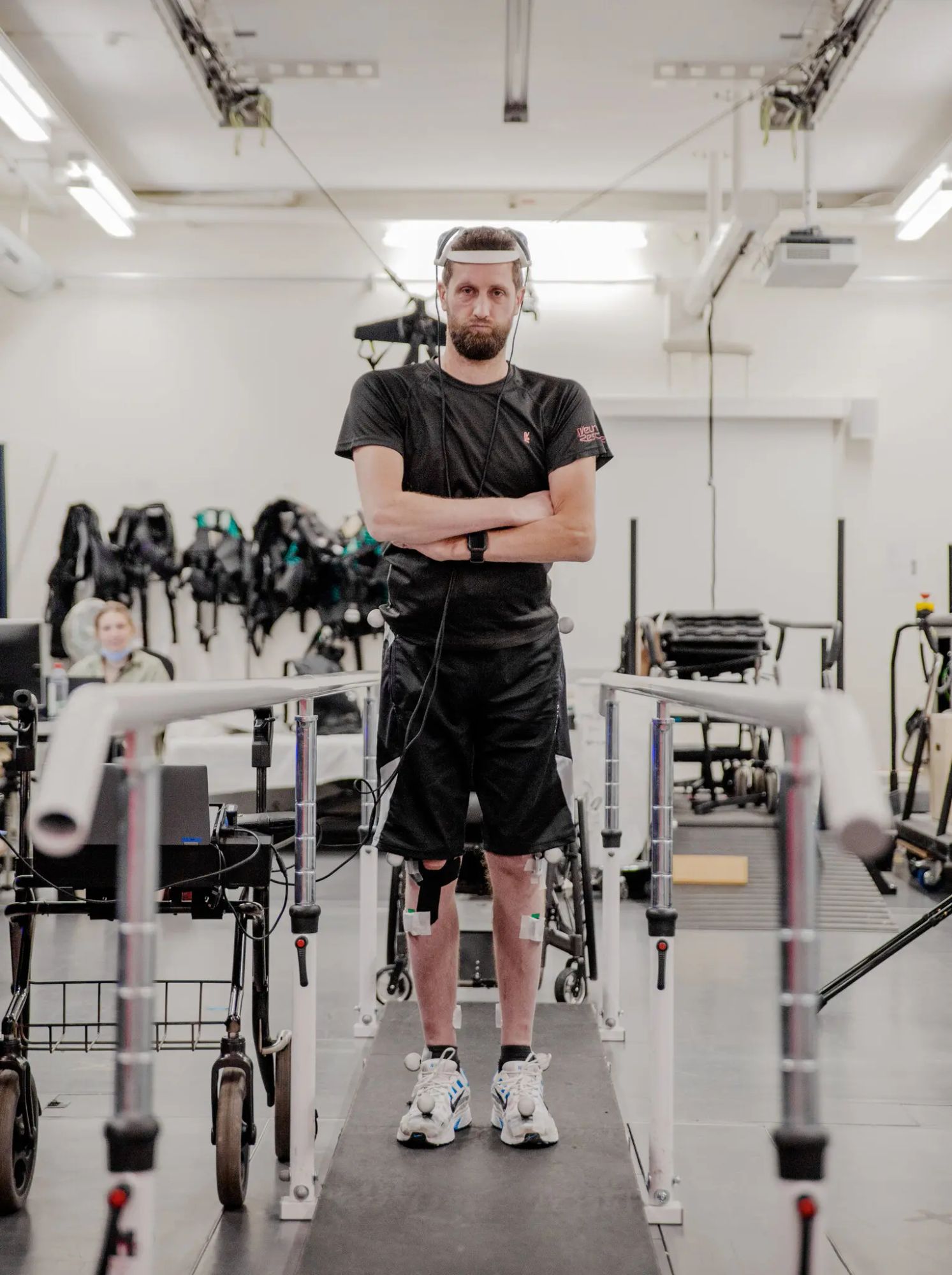
Twelve years after a motorcycle accident left him paralyzed from the hips down, Gert-Jan Oskam is walking again—thanks to AI-powered brain implants that act as a digital bridge between his thoughts and his muscles.
Swiss researchers have achieved what many thought impossible: restoring natural, voluntary movement to a completely paralyzed patient using implanted electrodes and artificial intelligence. The breakthrough, published in Nature, represents a seismic shift in spinal cord injury treatment and offers hope to millions living with paralysis worldwide.
"For 12 years, I've been trying to get back on my feet," Oskam said during the announcement. "Now I've learned how to walk naturally again." What makes this victory even more remarkable is that he retains improved mobility even when the device is turned off—suggesting his nervous system is actually recovering, not just being controlled.
The AI Magic: Decoding Thought Into Movement
Here's where the AI wizardry kicks in. Electrodes implanted in Oskam's brain record neural activity associated with specific movements. A machine learning system continuously analyzes these signals, learning the unique neural "fingerprints" for walking, standing, turning, and climbing. In real-time, this AI translates brain intention into targeted spinal cord stimulation, activating the exact muscles needed for movement.
Think of it as having a translator between your brain and spine—except this translator is powered by neural networks trained on thousands of neural patterns. The system gets smarter the more it's used, adapting to Oskam's natural recovery and neuroplasticity.
"We've captured Gert-Jan's thoughts and transformed them into spinal cord stimulation to re-establish voluntary movement," explained Grégoire Courtine, spinal cord specialist at the Swiss Federal Institute of Technology in Lausanne. "But unlike previous approaches, the patient controls the stimulation. He's not being controlled by it."
Why This Beats Previous Methods
Oskam had previously undergone spinal cord stimulation therapy, which offered temporary mobility improvements but felt robotic and disconnected. "The stimulation before was controlling me," he recalled. "Now I'm controlling the stimulation." That psychological shift is massive—it's the difference between being a puppet and being a person.
The AI-powered system achieves this through:
- Real-time neural decoding: AI algorithms process brain signals in milliseconds, not seconds
- Adaptive learning: The system learns from each movement, continuously improving accuracy
- Natural control: Oskam achieves intuitive, smooth movements rather than pre-programmed sequences
- Neurological recovery: Evidence suggests his spinal cord is actually healing, with some functions returning even when the implant is off
The Implant Architecture
The system isn't simple. Electrodes placed directly on Oskam's motor cortex (the brain region controlling movement) record neural activity. Wireless transmission sends these signals to an external AI processor running sophisticated decoding algorithms. The processed commands then reach spinal cord stimulators surgically positioned near the lumbar region, which activate targeted muscle groups through electrical pulses.
The entire loop—from thought to movement—happens in real-time, creating the illusion of direct neural control. It's brain-computer interface technology on steroids, supercharged by machine learning.
What Can He Do Now?
After months of therapy, Oskam can:
- Stand without external support
- Walk naturally with a walker across flat surfaces
- Navigate obstacles and uneven terrain
- Climb ramps and stairs with assistance
- Control walking speed intuitively
- Maintain these abilities even when the system is offline
This last point is crucial. The fact that Oskam retains improved mobility when disconnected suggests his nervous system hasn't become dependent on the implant—it's actually rewiring itself through neuroplasticity. His brain and spinal cord are healing.
The Neuroscience Behind the AI
The AI system uses deep learning to decode what neuroscientists call "population coding"—the idea that movement isn't encoded by individual neurons but by patterns across neural populations. By analyzing thousands of neurons simultaneously, the machine learning model captures the redundancy and richness of motor intention.
Traditional brain-computer interfaces struggled with this complexity. But modern neural networks excel at finding these high-dimensional patterns. The researchers trained their system on recordings from Oskam's motor cortex paired with his movement intentions, teaching the AI to recognize the neural signatures of "I want to walk forward" versus "I want to turn left."
FAQ: Your Burning Questions Answered
Q: Is this surgery reversible?
A: The implants can be removed, though they're currently meant as permanent solutions. Researchers are exploring less invasive options.
Q: How long does therapy take?
A: Oskam spent months in intensive physical therapy. Recovery timelines vary, but the AI system accelerates learning by providing real-time feedback.
Q: Could this work for arm paralysis?
A: Yes. Researchers believe the same approach can restore upper-body mobility, potentially enabling paralyzed patients to feed themselves, type, or perform fine motor tasks.
Q: What about cost?
A: Currently, the procedure is extremely expensive (estimated $100,000+), limiting access. This remains a major barrier to widespread adoption.
Q: Does the AI get better over time?
A: Absolutely. The neural decoder adapts as Oskam's brain recovers, continuously improving decoding accuracy. This creates a virtuous cycle of better movement and faster learning.
Q: Could the implant malfunction?
A: The system has multiple redundancies. Wireless communication provides safety margins, and the implants can be updated via software patches.
The Road Ahead: Scaling and Accessibility
While this breakthrough is extraordinary, scaling remains challenging. The procedure requires: - Neurosurgery for electrode implantation - Specialized AI engineers customizing the decoder - Months of physical therapy - Ongoing device maintenance
Researchers are working to standardize the approach, potentially reducing costs and expanding access. Companies like Neuralink and startups like Synchron are racing to commercialize similar technologies, suggesting we'll see broader patient populations treated within 5-10 years.
The real game-changer will be if less invasive implant methods (like implants that don't require brain surgery) can achieve similar results. That's the next frontier.
Why This Matters Beyond Paralysis
This technology hints at future applications: stroke recovery, traumatic brain injury, Parkinson's disease management, and even enhancement of healthy people's cognitive-motor abilities. The fundamental breakthrough—using AI to decode neural intent and translate it into real-world action—is broadly applicable to any neurological condition affecting movement or cognition.
It also raises philosophical questions: If an AI system is decoding your thoughts and controlling your body, are you still fully autonomous? As these technologies advance, we'll need serious ethical frameworks around consent, privacy, and cognitive liberty.
The Bottom Line
Gert-Jan Oskam's recovery represents more than a medical milestone. It's proof that paralysis isn't necessarily permanent. When you combine neurosurgery, brain-computer interfaces, artificial intelligence, and human determination, seemingly impossible recoveries become possible.
The next 12 years of paralysis research will likely see exponential improvements in this technology. Within a generation, spinal cord injury may shift from a lifetime disability to a treatable condition. And it's all happening because we taught machines to listen to what our brains are trying to say.
Learn More: