How AI Predicts Ice Swimming Deaths Before They Happen
Boris Oravec's near-drowning in Slovakia exposes a gap: we lack real-time AI systems to detect when athletes are in critical danger. Machine learning could revolutionize extreme sports safety by predicting disorientation, hypothermia, and oxygen depletion before they kill.

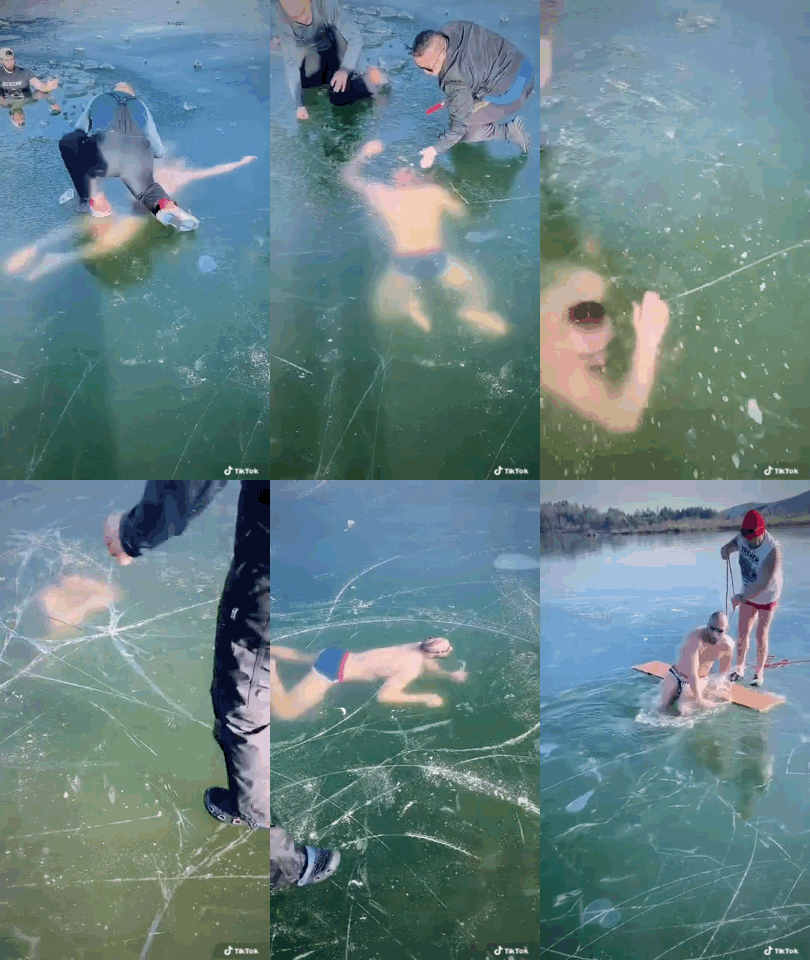
Ice swimming kills people every year, and we're not using AI to stop it. Boris Oravec nearly died in Slovakia because no algorithm was monitoring his cognitive decline in real time. He got disoriented under the ice—a classic sign of cold-induced brain dysfunction—but nobody detected it fast enough. Modern wearable sensors paired with machine learning could flag dangerous vitals before divers black out, yet most extreme athletes still swim without this tech.
By YEET Magazine Staff | Updated: May 13, 2026
Here's the gap: your smartwatch tracks heart rate, but it doesn't know what your heart rate *should* be at 35°F while holding your breath under frozen water. AI trained on thousands of cold-water incidents could.
Wearable sensors already exist. They measure core temperature, blood oxygen, heart rate variability, and even cognitive markers like reaction time. The problem? They're not connected to predictive algorithms that scream "ABORT MISSION" when data hits danger zones. Oravec's incident could've triggered automated alerts to safety divers: "Subject showing signs of cold-induced confusion. Recommend immediate extraction."
Machine learning companies are building this stuff for hospitals and military training. Extreme sports athletes? They're still operating on gut instinct and experience—which fails.
The data's there. Temperature, oxygen levels, heart rhythms. We just need algorithms smart enough to connect those dots faster than the human brain can process them at hypothermia.
Automation could save lives here. Real-time AI monitoring of extreme athletes isn't sci-fi. It's the logical next step. And it's cheaper than funerals.
The Tech That Should've Been There
Modern ice swimmers use basic dive computers. They show depth and time. That's it. No AI. No predictive risk assessment. No integration with surface safety teams.
A smart system would combine:
Wearable biometric sensors feeding continuous data to a cloud AI. Core temperature, oxygen saturation, EEG patterns. Real-time stuff.
Predictive algorithms trained on cold-shock responses. Machine learning models that know: at X temperature drop plus Y heart rate variability plus Z oxygen level, humans typically lose consciousness in 3-5 minutes.
Automated alerts to safety teams. Not optional. Mandatory. GPS-tracked divers get notifications the moment an athlete's data patterns suggest imminent danger.
Post-dive analysis. Every cold-water session becomes training data. The algorithm gets smarter. Individual profiles develop. Personalized danger thresholds emerge.
This exists in medical contexts. Hospitals use AI to predict sepsis, strokes, and cardiac events. Same logic applies to ice swimming. Same sensors. Same algorithms. Different stakes.
Why This Matters for the Future of Extreme Sports
Oravec's incident went viral. Millions watched a professional athlete nearly die on camera. That's engagement, sure. But it's also a data point.
Extreme sports are growing. More people are ice swimming, cliff diving, wingsuit flying—activities where the margin between thrilling and dead is milliseconds. Insurance companies are starting to demand safety tech. Sponsors want liability protection. Athletes want to survive.
Automation isn't about removing risk. It's about removing *preventable* death. The kind where someone's brain shuts down before they realize it, and nobody topside knows until it's too late.
AI can solve that. It won't make ice swimming safe—nothing will. But it can make it measurably less lethal.
The Bigger Picture: Automation in Extreme Sports
This extends beyond ice swimming. Automation and AI are reshaping how we approach high-risk activities:
Drone safety monitors. Autonomous drones tracking climbers, BASE jumpers, and free divers. Real-time altitude, velocity, and biometric data sent to ground crews. No human pilot fatigue.
Algorithm-driven rescue dispatch. When sensors detect an emergency, AI automatically alerts the nearest qualified rescue team. Cuts response time from minutes to seconds.
Personalized risk profiles. Machine learning learns your body's responses to stress, cold, altitude, oxygen deprivation. It predicts your breaking point before you reach it.
Wearable redundancy. Multiple sensors with automatic failover. If one sensor fails, others compensate. AI validates data integrity in real time.
The technology exists. The barriers are adoption, regulation, and cost. But as more athletes die from preventable causes, automation becomes less optional and more inevitable.
What We're Missing Now
Ice swimmers operate in a low-tech bubble. Most safety protocols rely on buddy systems and experience. That works—until it doesn't.
Oravec had divers standing by. He had support teams. He had experience. None of it mattered when his disoriented brain couldn't communicate distress signals fast enough.
An AI-powered system would've caught the cognitive decline automatically, pulling him up before consciousness faded. No reliance on the athlete recognizing his own danger. Algorithms don't get disoriented. They don't panic. They just react.
That's the future of extreme sports safety. Not bans. Not restrictions. Just better data, smarter algorithms, and faster automation.
The tech already works in hospitals, military bases, and elite training facilities. Ice swimming communities just need to adopt it. Fast.
Questions People Actually Ask
Could AI have prevented Boris Oravec's near-drowning? Probably. If real-time cognitive monitoring and automated alerts were in place, surface teams would've extracted him the moment disorientation started showing in his biometric data. Cold-induced confusion is detectable before it becomes life-threatening.
What sensors would an ice swimming safety system need? Core temperature probe, pulse oximetry, heart rate variability monitor, and optionally an EEG headset to detect cognitive impairment. All of this tech exists. It just needs integration with predictive AI.
How fast could AI alert divers to an emergency? Modern systems can process data and trigger alerts in under 100 milliseconds. That's faster than a human observer can consciously react. It could buy someone like Oravec the critical minutes they need.
Would this stop people from ice swimming? No. But it would shift the risk calculus. Right now, ice swimming feels uncontrollable. AI-powered safety makes it feel manageable. That might actually *increase* adoption among people who want the experience without the death lottery.
Why isn't this standard yet? Cost, regulation, and culture. Extreme sports communities are independent-minded. They resist mandates. But as insurance premiums rise and liability concerns grow, automation will become expected, then required.
What's the next step? Prototype wearable systems specifically designed for ice swimmers. Partner with research institutions. Test on trained athletes. Build a dataset. Train the algorithms. Deploy. Iterate. Save lives through data.
Related Reading
Check out how wearable AI is transforming athlete monitoring across extreme sports.