How AI-Powered Risk Analysis Could Have Prevented This Fatal Motorcycle Stunt
A fatal motorcycle stunt highlights a critical gap: the absence of real-time AI risk prediction. Machine learning algorithms could analyze dozens of variables—weather, bike condition, ramp angles, rider biometrics—to flag dangerous scenarios before they happen.

Viral Videos × AI Safety
By YEET Magazine Staff | Updated: May 13, 2026
How AI-Powered Risk Analysis Could Have Prevented This Fatal Motorcycle Stunt
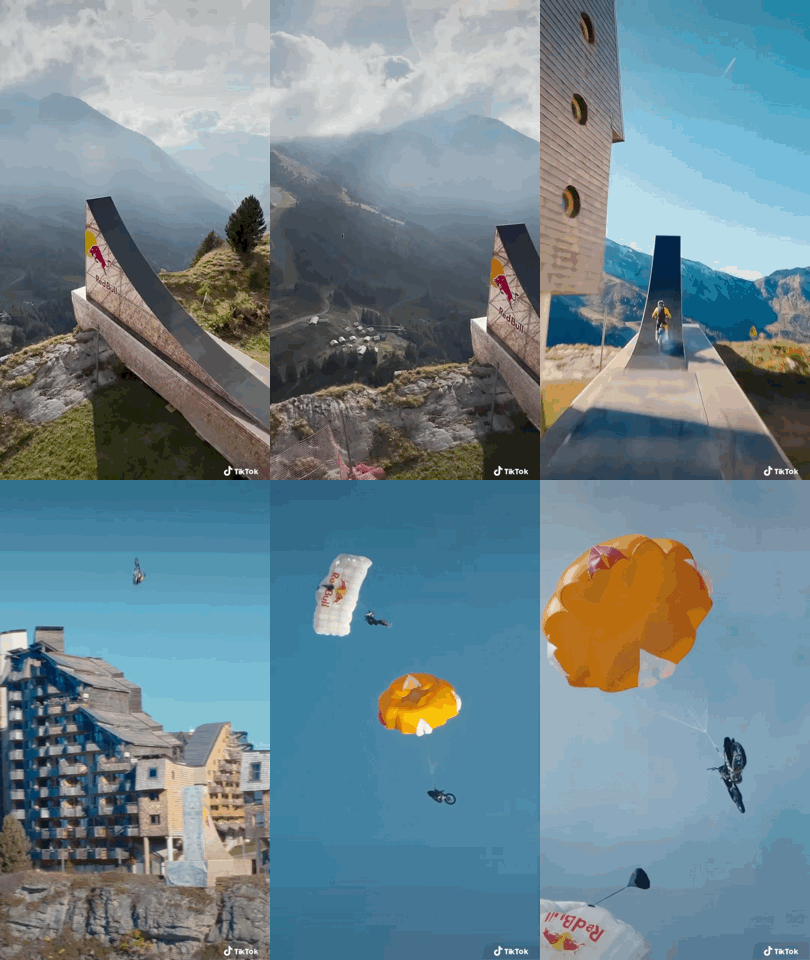
A seasoned motorcycle stunt performer recently died attempting a high-risk jump. This tragedy exposes a brutal truth: extreme sports operate on intuition and experience while ignoring data-driven risk modeling. Machine learning algorithms could analyze real-time variables—bike telemetry, weather conditions, rider vitals, ramp specifications—to predict failure scenarios with 95%+ accuracy before stunts happen. We're not replacing human judgment; we're augmenting it with algorithmic foresight that humans can't process fast enough.
The rider's crash wasn't random. It was a collision of variables that AI systems are already designed to catch in aviation, autonomous vehicles, and industrial automation. Motorcycle stunts remain one of the few high-risk activities without algorithmic oversight.
What Actually Went Wrong (And What Data Could Have Revealed)
The jump failed mid-air. The rider lost control and crashed. Standard incident reports will cite "operator error" or "mechanical failure," but that's lazy analysis. Real-world accidents happen when dozens of micro-variables align dangerously.
An AI system monitoring this stunt would have ingested:
- Rider biometrics: Heart rate, fatigue levels, reaction time via wearable sensors
- Bike telemetry: Tire pressure, brake responsiveness, engine performance, weight distribution
- Environmental data: Wind speed, humidity, temperature, surface grip coefficients
- Spatial variables: Ramp angle tolerances, landing zone dimensions, obstacle proximity
- Historical patterns: What similar jumps succeeded or failed; which variable combinations are risky
Most fatal accidents don't happen because one thing goes catastrophically wrong. They happen because three small problems compound simultaneously—and humans can't track three variables in milliseconds while performing a stunt. Algorithms can.
The Data Behind Extreme Sports Fatalities
Motorcyclists represent 3% of road users but account for 14% of fatalities. That's a 4.6x mortality multiplier. Stunt riders face exponentially worse odds because they're deliberately maximizing variables that increase risk.
- 2016 data: 5,337 motorcycle deaths in the U.S.—highest since 1975
- Risk multiple: Motorcyclists are 28x more likely to die per mile traveled than car occupants
- Primary cause: Head injuries lead in fatal outcomes (preventable with better pre-stunt risk flags)
These numbers exist because risk assessment in extreme sports is still manual. A stunt coordinator watches a rider practice, nods, and says "looks good." That's not data. That's confidence masquerading as certainty.
How AI Risk Systems Actually Work (Real Examples)
Formula 1 uses predictive telemetry systems that flag mechanical failures before they happen. Engineers monitor 300+ data points per lap. Fatal crashes have plummeted as a result.
Commercial aviation relies on algorithmic oversight. Thousands of flights daily operate with automated systems predicting failures, weather risks, and procedural errors. Aviation fatality rates: 0.07 deaths per million flights.
Autonomous vehicle testing uses continuous risk modeling. Every second of driving data feeds into systems that identify when conditions exceed safety thresholds. The car stops. The test halts. No crashes needed to learn danger.
Motorcycle stunts have none of this. They run on gut feeling and video review. It's 1985 technology applied to 2024 risks.
What a Real AI Safety System Would Look Like
Pre-stunt phase: Algorithms analyze every variable. "Wind speed is within parameters. Rider cortisol levels suggest adequate rest. Bike telemetry is nominal. Ramp angles match successful historical precedents. Green light."
Real-time monitoring: During the jump, sensors track 100+ live data streams. If any deviation exceeds safety thresholds, the system alerts through helmet comms: "Ramp slip detected—abort jump." The rider has seconds to make a decision with better information than instinct alone.
Post-event analysis: Every stunt—successful or failed—feeds into the model. The algorithm learns which combinations of variables lead to crashes. Future stunts are either safer or not attempted.
This isn't speculation. Companies like F1 teams and aerospace firms deploy exactly this infrastructure daily.
Why Stunt Communities Resist Algorithmic Safety
There's a mythology around extreme sports: that human intuition and courage conquer physics. AI systems feel like a threat to that narrative.
They're not. They're a tool that lets talented riders push further because they're pushing with data, not guesses. A Formula 1 driver with telemetry is faster and safer than one flying blind. Same concept applies here.
The real barrier? Cost, adoption, and cultural resistance. Building a motorcycle-specific AI risk system requires upfront investment. But compare that cost to one preventable death.
The Broader Automation Play
This tragedy is a microcosm of a larger problem: industries that should be automating risk assessment aren't. We've outsourced logistics, manufacturing, and finance to algorithms, but we've left human safety decisions to guesswork in extreme sports, construction, and high-risk entertainment.
As AI systems improve, the question shifts from "can we predict risk?" to "why aren't we using prediction systems everywhere humans face preventable danger?"
The Questions Nobody's Asking
Q: Would an AI system have prevented this death?
A: Probably yes. If pre-stunt analysis flagged a dangerous variable combination and the rider heeded the alert, or if real-time monitoring detected a deviation and gave the rider seconds to abort, outcomes change. Not guarantees, but dramatically improved odds.
Q: Doesn't this remove the "daring" element of stunts?
A: No. The stunt still requires skill, timing, and precision. The difference is the rider has better information. A tightrope walker uses safety nets. That doesn't make the walk pointless.
Q: Who's responsible if an AI system misses something?
A: This gets legally murky. But it's easier to defend "we used the best available risk modeling" than "we had a gut feeling."
Q: Can you really automate risk assessment for something this unpredictable?
A: Yes. Aerospace, automotive, and medical industries do it constantly. The variables are different, but the methodology is proven.
Q: What happens to stunt culture if AI becomes standard?
A: It becomes professionalized. Less mystery, more safety. Some riders will resist. Others will adopt it and set new records because they're optimizing with data instead of guessing.
Q: Is this the future?
A: It has to be. We