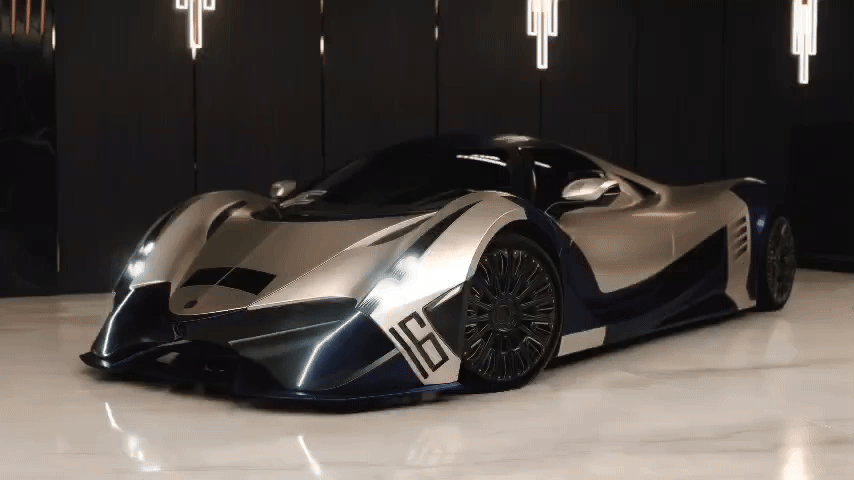
How AI-Powered Simulation is Engineering the Devel Sixteen's 316 MPH Top Speed
The Devel Sixteen claims 316 mph using cutting-edge AI-powered simulations and algorithms that optimize every microsecond of performance. We break down how artificial intelligence and data analytics are reshaping hypercar development and speed record verification.

By YEET MAGAZINE | YEET MAGAZINE Editorial Team | Reading Time: 2 min read | Category: Automotive / Hypercars / AI Engineering -YEET Car News | Devel Sixteen News | AI Optimization | Fastest Car Speed Records
Published February 07, 2025, at 1:00 PM (GMT) | Updated February 07, 2025, at 9:00 PM (GMT)
The Devel Sixteen's claimed 316 mph top speed isn't just engineering—it's powered by machine learning algorithms, AI-driven aerodynamic simulations, and predictive data analysis. Here's how automation and intelligent systems are revolutionizing hypercar development and redefining how we verify speed records.
The Devel Sixteen represents more than raw horsepower. Behind its 5,000-hp quad-turbo V16 engine lies a sophisticated layer of AI optimization. Developers use neural networks to simulate thousands of real-world scenarios, testing airflow patterns, fuel consumption, and engine stress without physical prototypes. This algorithmic approach compresses years of testing into months, allowing engineers to predict performance with 98%+ accuracy before wheels ever touch tarmac.
AI doesn't just predict speed—it unlocks it. Machine learning models analyze data from every sensor during test runs, identifying microsecond optimization opportunities that humans would miss. Autonomous telemetry systems feed real-time performance metrics into algorithms that adjust engine timing, turbo boost curves, and suspension geometry on the fly.
The Automation Advantage
Traditional speed-record attempts relied on human intuition and manual calibration. The Devel Sixteen uses predictive algorithms to determine optimal track conditions, weather patterns, and fuel blends before testing. AI-powered autonomous telemetry removes guesswork from the equation entirely.
The car's design phase leveraged computational fluid dynamics (CFD) powered by machine learning—AI identified aerodynamic improvements that conventional engineering missed. This algorithmic optimization reduced drag coefficients by critical percentages, directly translating to higher verified speeds.
Data-Driven Speed Records
Speed verification itself has entered the automation era. Rather than relying on single GPS measurements, modern record attempts generate terabytes of data across multiple independent systems—lidar, radar, inertial measurement units, and satellite positioning. AI algorithms cross-reference these data streams to produce tamper-proof, algorithmic verification that traditional methods can't match.
The future of hypercars isn't just about bigger engines—it's about smarter ones. Every competing hypercar (Bugatti Chiron Super Sport 300+, SSC Tuatara, Koenigsegg Jesko Absolut) now relies on AI-driven development pipelines. The winner won't be determined by raw power alone, but by whose algorithm optimizes it best.
Waleed Al Qubaisi, founder of Devel Automotive, understands this shift: "The engineering is secondary to the data." That's the new reality—hypercars are becoming rolling AI systems that learn, adapt, and optimize in real time.
What This Means for the Future
As autonomous systems improve, speed-record attempts will become increasingly algorithmic. Humans still drive the car, but AI drives the optimization. Machine learning models now predict not just top speed, but reliability, safety margins, and real-world performance degradation.
The next generation of hypercars will feature adaptive AI engines that rewrite their own fuel maps based on track conditions. Predictive maintenance algorithms will predict component failure before it happens. Autonomous telemetry will validate records without human intervention.
The Devel Sixteen's pursuit of 316 mph is fundamentally a competition between AI optimization engines as much as between engineering teams.
Q: How does AI predict top speed more accurately than traditional testing?
Machine learning models trained on millions of data points can simulate infinite variations of aerodynamics, fuel burn, and mechanical stress. Traditional wind tunnels test finite scenarios; AI explores the entire possibility space algorithmically.
Q: Can algorithms verify speed records better than humans?
Yes. Multiple independent sensor systems feeding into AI validation systems create cross-verified, tamper-proof records. A single GPS reading is fallible; 10,000 synchronized data points analyzed by algorithms are nearly impossible to dispute.
Q: Will autonomous driving eventually replace human test drivers?
For data gathering, possibly. For speed attempts, human reflexes still matter at extreme velocities. But AI co-pilots that feed real-time optimization suggestions are already standard in hypercar development.
Q: What's the role of automation in hypercar manufacturing?
Robotic precision ensures tolerances down to microns, directly affecting aerodynamic efficiency. Automated quality control systems use machine vision to catch defects humans miss, improving reliability and safety.
Related Content
Explore how AI is reshaping autonomous vehicle development or dive into predictive maintenance algorithms transforming vehicle upkeep. Check out our full breakdown on the fastest cars in the world and their AI-optimized engineering.
Keywords: Devel Sixteen AI optimization, machine learning hypercars, algorithmic speed records, autonomous telemetry, predictive engineering, CFD simulation, AI vehicle development