How AI Logistics Failed to Prevent the Suez Canal Disaster: The $9B Supply Chain Breakdown
When the Ever Given got stuck in the Suez Canal, it revealed a harsh truth: our most advanced AI logistics systems completely failed to prevent or mitigate a $9 billion economic disaster. What went wrong with the algorithms designed to optimize global trade?

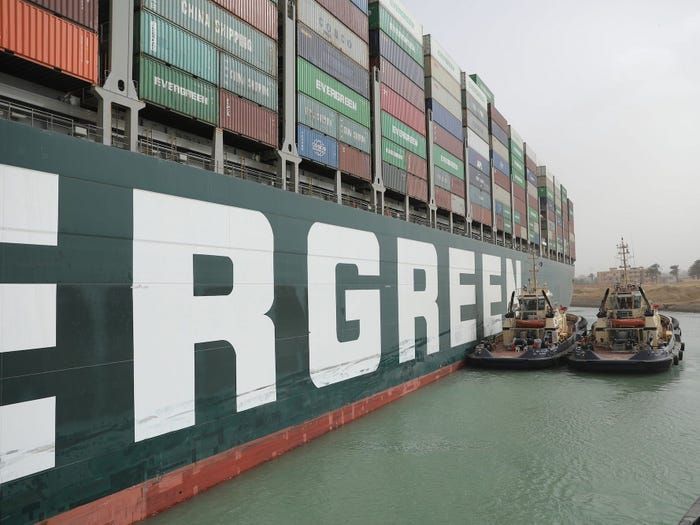
The Ever Given's blockade exposed a critical failure in AI-powered logistics systems worldwide. Algorithms designed to predict disruptions, optimize routes, and manage inventory across global supply chains simply didn't catch what should have been catastrophic. The ship stuck for six days, halting $9-15 billion in daily trade flow. Modern predictive analytics failed. Real-time monitoring systems didn't trigger alerts early enough. Automated rerouting protocols couldn't adapt fast enough. The gap between what we thought AI could do and what it actually delivered became painfully visible to every company relying on global trade.
By YEET Magazine Staff | Updated: May 13, 2026
The Suez Canal normally handles 12% of world trade. That's roughly $300 billion in goods per month passing through that single chokepoint. When the Ever Given got wedged sideways on March 23, 2021, it didn't just block a ship—it broke the nervous system of global commerce.
The immediate chaos was staggering. Within hours, nearly 400 ships queued up on both sides. Insurance companies scrambled. Manufacturers in Asia couldn't ship products to Europe. European factories couldn't get raw materials. Retailers across North America faced empty shelves weeks later. The economic damage estimates ranged from $6.7 billion to $15 billion depending on duration.
Here's where AI's failure gets interesting: shipping companies have been investing heavily in predictive analytics, machine learning models, and algorithmic route optimization for years. These systems are supposed to account for weather, traffic patterns, port congestion, fuel costs, and vessel specifications. Yet somehow, none of these "intelligent" systems saw the problem coming or adapted quickly enough to minimize damage.
The real issue wasn't the technology itself—it was the false confidence in automation. Most supply chain algorithms are trained on historical data. They optimize for normal conditions. A 400-meter container ship getting sandwiched sideways in a narrow canal during a dust storm? That's an outlier. Outliers break algorithms.
The shipping industry also lacked real-time visibility across the entire supply chain. Companies could track their own containers, but nobody had a unified AI system monitoring global trade flow holistically. Data silos meant no single algorithm could see the ripple effects spreading across industries. The automotive industry didn't know semiconductor shipments were blocked. Electronics manufacturers didn't realize their components were stuck. Everyone found out through news alerts, not data alerts.
Automation actually made things worse in some cases. Ports operated by automated scheduling systems couldn't quickly pivot to handle the backup on alternate routes. Inventory management algorithms kept ordering goods destined for blocked routes, creating phantom demand. Supply chain visibility platforms went dark because they relied on regular data feeds from the Suez that suddenly stopped.
What we learned: AI is fantastic at optimization within known parameters. It's terrible at handling black swan events. The Suez blockade wasn't a system failure—it was a system design failure. We built logistics algorithms that maximize efficiency in stable conditions, not resilience in crisis conditions.
Smart companies immediately started redesigning their systems post-crisis. They added redundancy into their AI models. They trained algorithms on worst-case scenarios, not just historical averages. They built human override protocols back into automated systems. They created real-time data sharing networks that feed into shared decision-making systems.
The cost of waiting six days to physically excavate a ship? Massive. But the longer-term cost was realizing our automation infrastructure had a critical blind spot. We optimized for speed and cost savings without building in resilience.
Now supply chain companies are retrofitting their AI with scenario-based learning. Algorithms that can simulate supply chain shocks before they happen. Predictive models that account for geopolitical risk, climate events, and infrastructure vulnerabilities. Real-time dashboards that feed into human decision-making loops instead of fully automated response systems.
The Ever Given taught us an expensive lesson: automation without adaptability is just fragility wearing a tech costume. The next generation of supply chain AI needs to be intelligent about its own limitations.
What people actually ask about this stuff:
Could AI have prevented the ship from getting stuck? No. But it could have triggered port diversions, container transfers, and alternative route planning within hours instead of days. The problem was delayed human decision-making, not the ship's navigation AI.
Why didn't port automation systems just adapt? Most port systems are siloed. Each port runs its own algorithms. There's no unified network sharing real-time capacity data. A port in Singapore had no idea Rotterdam was about to get overloaded. Automation only works within single nodes, not across networks.
Did companies actually use AI to predict supply chain shocks after this? Some did. Others just added physical redundancy (keeping extra inventory, using multiple suppliers). Hybrid approaches—AI recommendations + human judgment + built-in buffer capacity—became standard practice.
What's the current state of supply chain AI? Much better. Cloud-based platforms now aggregate data from multiple sources. Machine learning models test thousands of scenarios daily. Real-time visibility platforms exist. But it's still fragmented by industry and geography. No true global supply chain optimization exists yet.
Could this happen again? Absolutely. The Suez isn't the only chokepoint. Panama Canal, Strait of Malacca, port infrastructure worldwide—all vulnerable. AI helps with response time, but if the algorithm doesn't account for your specific risk, you're still exposed.
Is automation making supply chains more fragile? Not inherently, but cost-cutting optimization did. Companies squeezed out slack (extra inventory, redundant suppliers, buffer capacity) to maximize efficiency. That worked fine until it didn't. Modern AI-driven supply chains are building slack back in, but it's expensive.
Related reading that connects:
Check out our piece on how automation is reshaping warehouse operations for context on why ports are so dependent on optimized systems.
We also covered why predictive algorithms fail at black swan events—the Suez blockade is the perfect real-world case study.
And if you want to understand the broader economic impact of supply chain disruption, read how companies are redesigning work around supply chain resilience.
HTML_CONTENT