French Café Charges Extra for Rudeness: How AI Could Detect Customer Politeness
A French café in Nice implemented a pricing scheme charging extra for rudeness—€7 for no greeting, €1.40 for polite orders. Now AI sentiment analysis could automate such politeness detection across hospitality worldwide.

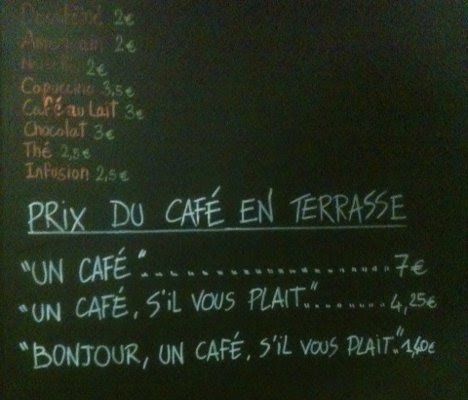
The Petite Syrah café in Nice, France, has become an international symbol of politeness enforcement through creative pricing—and it's raising fascinating questions about how artificial intelligence could revolutionize customer service standards in the hospitality industry. The French café's owner, Fabrice Pepino, implemented a simple but bold strategy: charge customers different prices based on the politeness of their ordering language, sparking conversations about manners, automation, and behavioral analysis in the modern world.
By YEET Magazine Staff | Published: 2019-09-21
At the heart of this French café's approach lies a deeply human problem: stressed customers rushing through lunch without basic courtesies. Yet what started as a humorous sign at the Petite Syrah—€7 for "a coffee," €4.25 for "a coffee please," and just €1.40 for "Hello, a coffee please"—now illustrates how emerging AI technologies could eventually automate and scale such politeness-based systems across hospitality globally. Natural language processing (NLP) and sentiment analysis algorithms are already sophisticated enough to detect tone, formality, and courtesy markers in customer interactions, raising the question: could AI one day manage customer politeness standards the way the French café does manually?
The French Café's Politeness Pricing System Explained
The French are legendary for their commitment to everyday formalities and social courtesies. Walking into a French establishment without offering a "Bonjour" is considered jarring, and purchasing a baguette requires the mandatory greeting. Even elevator departures warrant wishes of good afternoon to complete strangers. For Fabrice Pepino and his team at the Petite Syrah, the challenge wasn't maintaining their own politeness standards—it was managing increasingly stressed customers who abandoned theirs during busy lunch hours.
The café's three-tier pricing structure brilliantly gamified politeness without creating genuine financial hardship. A customer barking orders suffered the highest price, while those offering basic pleasantries received modest discounts. Most importantly, those who combined greeting with politeness got the best deal—a mechanism that rewarded full social engagement. What Pepino didn't anticipate was that the sign itself would become a behavioral modification tool, with regulars exaggerating their politeness and joking with staff rather than rushing through transactions.
How AI Sentiment Analysis Could Replicate This System
The Petite Syrah's approach relies on human judgment to interpret customer tone and politeness. But modern AI sentiment analysis—powered by deep learning models trained on millions of conversation examples—can now detect subtle linguistic markers that indicate courtesy, respect, and emotional state. These systems analyze word choice, punctuation, sentence structure, and even vocal tone when audio is available, assigning confidence scores to determine overall sentiment.
Imagine applying this technology across hospitality: voice-activated ordering systems at cafés could analyze customer tone in real-time, with AI systems flagging discourteous interactions and adjusting pricing accordingly. Chatbot systems could detect aggressive or dismissive language and respond with higher fees or service limitations. More practically, AI could alert human staff when customers are becoming frustrated, enabling proactive de-escalation before problems worsen. The French café's manual system becomes automated, scalable, and data-driven through machine learning.
The Ethical Implications of AI-Powered Politeness Enforcement
However, scaling the Petite Syrah's concept through AI raises serious concerns. Unlike Fabrice Pepino's clearly humorous and lighthearted approach, algorithmic politeness enforcement could feel cold, arbitrary, and even discriminatory. AI sentiment models are notoriously prone to bias—systems trained predominantly on specific dialects, accents, or communication styles often misinterpret others. A customer with a regional accent, neurodivergence affecting tone, or cultural communication norms different from the training data could be unfairly penalized by an AI system that the French café would have handled with human understanding.
Moreover, the Petite Syrah works precisely because regulars understand the joke and see it as a lighthearted nudge toward community standards. An automated AI system lacks that human warmth and contextual judgment. It cannot distinguish between someone genuinely stressed and someone naturally speaking in clipped sentences. It cannot recognize the regular customer having a bad day or the newcomer unfamiliar with French social norms. The café's success stems from its transparency and humor—qualities difficult to replicate in algorithmic systems, which often feel opaque and punitive.
The Psychology Behind the French Café's Success
What makes the Petite Syrah's pricing scheme work psychologically is its combination of humor, clarity, and community reinforcement. The sign is visible to all customers, eliminating the sense of arbitrary punishment. The price differences are modest enough to be amusing rather than punitive. And because Fabrice Pepino admits he's never actually enforced the premium prices, the system functions more as a gentle nudge than a penalty system. Customers appreciate being part of an inside joke—they began calling him "your greatness" and exaggerating their politeness playfully.
AI systems, by contrast, would likely apply rules consistently and visibly, removing the flexibility that makes human enforcement bearable. If an AI system actually charged higher prices based on sentiment analysis, customers would feel monitored and judged by machines rather than gently ribbed by a human manager. The psychological impact shifts from "we're all in this together" to "the algorithm is watching you," which tends to breed resentment rather than behavioral change.
Real-World AI Applications in Customer Service
Despite these concerns, AI-powered politeness and sentiment detection is already being deployed in customer service environments. Call center AI systems monitor agent interactions and customer satisfaction in real-time, flagging escalating tensions and recommending de-escalation strategies. Retail environments are testing emotion recognition systems that alert staff when customers appear frustrated. Airlines and hotels use predictive AI to identify high-risk interactions before they occur, enabling proactive service recovery.
These applications generally use AI as a tool to improve service rather than penalize customers, which aligns better with hospitality's core mission. Instead of charging extra for rudeness, AI could identify stressed customers and offer them priority service, complimentary refreshments, or genuine human attention—using politeness standards to improve the experience rather than extract additional revenue.
Could the French Café Model Scale to Other Industries?
The Petite Syrah's model has generated international attention precisely because it's both shocking and charming. Other hospitality venues have considered similar approaches, though few have implemented them as openly. A restaurant in Russia tried charging extra for elbows on the table (an old etiquette rule). Some venues have experimented with "attitude fees" or "smile surcharges." Yet none have captured the same cultural moment as the French café's politeness pricing, partly because none combined it with the distinctly French cultural context where such social standards are genuinely important to the community.
Scaling this concept through AI would require adapting to different cultural contexts where politeness norms vary dramatically. Japanese communication emphasizes indirect courtesy and silence; German communication values directness; American communication prioritizes casual friendliness. An AI system optimized for one culture would inevitably misinterpret others, creating exactly the kind of unfair automated discrimination that regulations like GDPR and emerging AI governance frameworks aim to prevent.
The Future: Human Judgment Remains Essential
The Petite Syrah's long-term success will likely depend on keeping politeness enforcement fundamentally human. Fabrice Pepino's choice to never actually enforce the premium prices, combined with his obvious amusement at customers' exaggerated politeness, is precisely what prevents the system from becoming oppressive. His judgment allows for context, cultural differences, and individual circumstances—qualities that remain the domain of human management rather than algorithmic systems.
If AI tools are deployed in hospitality settings, they should function transparently as decision-support systems rather than autonomous judges. An
Frequently Asked Questions
Q: How does the Petite Syrah café's pricing system work?
A: The café in Nice, France charges different prices based on politeness. A customer ordering "a coffee" pays €7, "a coffee please" costs €4.25, and "Hello, a coffee please" is only €1.40. Owner Fabrice Pepino implemented this system to encourage basic courtesies from rushed customers.
Q: Could AI technology replicate this politeness-based pricing?
A: Yes, potentially. Natural language processing (NLP) and sentiment analysis algorithms are already sophisticated enough to detect tone, formality, and courtesy markers in customer interactions. This technology could eventually automate and scale politeness-based systems across the hospitality industry.
Q: What is the broader purpose of the café's approach?
A: Beyond the pricing gimmick, the Petite Syrah addresses a deeply human problem: customers rushing through service without basic manners. The system has become an international symbol of how creative pricing can enforce politeness standards and raise questions about behavioral analysis and automation in modern customer service.