Maid of Honor's T-Rex Costume: How AI Could Predict Wedding Dress Code Disasters
Nebraska maid of honor Christina Meador's T-Rex costume at her sister's wedding went viral after being told she could wear 'anything.' We explore how AI-powered wedding planning tools could interpret ambiguous dress codes and prevent similar mishaps.

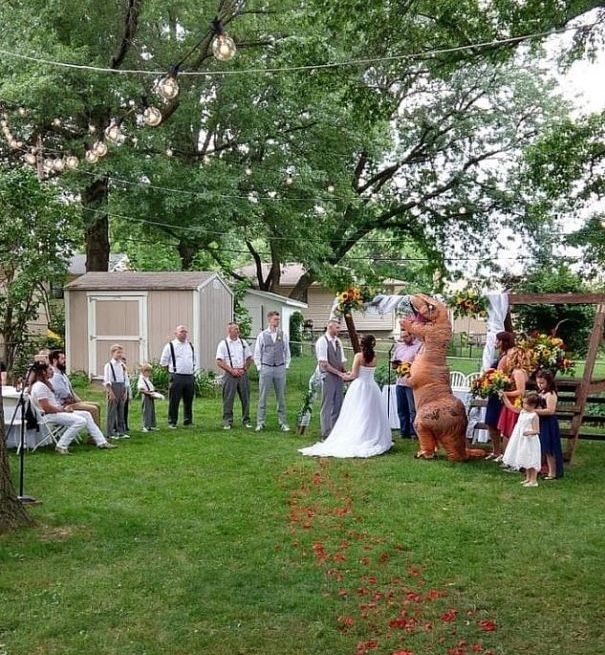
Maid of Honor Christina Meador's T-Rex Costume Sparks Conversation About AI Wedding Planning Tools
By YEET Magazine Staff | Published: 2019-09-04
When Nebraska maid of honor Christina Meador received the green light to wear "anything" to her sister Deanna Adams's wedding, she took the instruction literally—arriving in a full-sized T-Rex dinosaur costume that has since become an internet sensation. The photo of Meador towering over the bridal party in her prehistoric outfit has garnered over 35,000 shares on social media, raising an interesting question: In an era of artificial intelligence and smart event planning, could AI-powered wedding coordinators have prevented this amusing dress code disaster?
The viral moment highlights a real problem in wedding planning: miscommunication. While Deanna Adams gracefully accepted her sister's unconventional fashion choice, stating "My sister is awesome and I genuinely was not kidding when I said she could wear whatever she wanted," the incident reveals how vague instructions can lead to unexpected outcomes. This is where artificial intelligence could revolutionize the bridal experience.
The Rise of AI in Wedding Planning
Modern couples are increasingly turning to AI-powered wedding planning platforms to manage everything from guest lists to vendor coordination. These intelligent systems can analyze natural language instructions and provide clarification when ambiguity exists. Had Deanna Adams used an AI wedding planner, the system could have flagged her instruction "wear anything" as potentially problematic and suggested clearer guidelines, such as "wear formal attire in your favorite color" or "dress in black-tie optional style."
Machine learning algorithms excel at understanding context and nuance that humans might miss. When Christina Meador's maid of honor message arrived with her outfit selection, an AI system could have cross-referenced the wedding's formal tone, the venue type, and standard bridal party expectations to identify potential dress code violations before they occurred.
How Maid of Honor Christina Meador's Costume Reflects a Bigger Wedding Trend
The maid of honor's T-Rex costume moment isn't just funny—it's emblematic of how modern weddings are becoming more personalized and unconventional. Many couples now reject traditional bridal party aesthetics in favor of authenticity and self-expression. Christina Meador's willingness to commit to the dinosaur bit demonstrates this shift toward personality-driven celebrations.
However, this trend creates planning challenges. AI solutions could bridge the gap between creative freedom and coordinated elegance by learning a couple's style preferences, analyzing their wedding vision through photos and mood boards, and then generating customized dress codes for each member of the bridal party. Such systems would understand that some couples (like Deanna Adams) genuinely want unconventional expressions, while others need stricter guidelines.
Machine Learning and Social Media Virality
The maid of honor's costume became viral precisely because it violated expectations. AI algorithms that power social media platforms are designed to identify and promote content that generates engagement through surprise or humor. In this case, the contrast between formal wedding photography and a full T-Rex costume triggered algorithmic amplification, resulting in millions of views across multiple platforms.
This raises another interesting application for AI in wedding planning: predictability analysis. Before a wedding event, AI could analyze social media trends and predict which moments are most likely to go viral, helping couples decide whether they want their special day optimized for Instagram engagement or traditional privacy.
Automation in Bridal Party Communication
One of the most practical applications of AI in the wedding industry is automated communication with bridal parties. Instead of relying on unclear texts or emails, AI assistants could send detailed, personalized messages to each bridesmaid and groomsman that include:
- Specific color palette requirements
- Dress code formality levels (black-tie, cocktail, semi-formal, etc.)
- Budget recommendations
- Style inspiration based on individual body types and preferences
- Timeline reminders for fittings and final confirmations
- Real-time updates if plans change
Christina Meador's T-Rex costume situation could have been entirely avoided with such a system, which would have provided crystalline clarity rather than open-ended creative freedom.
The Human Element vs. AI Precision
Yet here's the beautiful irony: Deanna Adams's wedding was arguably made more memorable because of the maid of honor's costume choice. The bride's decision to embrace her sister's interpretation of "wear anything" created a genuine moment of joy and sisterly connection that no AI algorithm could have engineered. While technology can improve clarity and reduce miscommunications, it can also strip away the spontaneity and authenticity that makes weddings special.
The maid of honor's willingness to wear the T-Rex costume—and the bride's acceptance of it—speaks to a relationship that transcends rigid formality. This is something AI wedding planners should recognize and encourage rather than eliminate. The goal isn't to make all weddings identical through algorithmic optimization; it's to clarify intentions while still allowing room for genuine human expression.
Industry Implications of the Christina Meador Moment
Wedding planners have noted a significant shift in how modern couples approach bridal party guidelines. Younger generations are less concerned with rigid aesthetic uniformity and more interested in having friends and family feel comfortable and authentically represented. The maid of honor's viral T-Rex costume moment has actually become a reference point in industry discussions about inclusivity and personal expression in wedding celebrations.
AI tools designed for the wedding industry are now being programmed to recognize and respect these preferences. Advanced systems can now differentiate between couples who want:
1. Strict uniformity: All bridesmaids in identical dresses, specific colors, matching accessories
2. Guided flexibility: A color palette and formality level, with individual style choices within those parameters
3. Maximum freedom: Like Deanna Adams, genuinely open-ended options with minimal restrictions
By using natural language processing, AI can identify which category a couple falls into and then provide guidance to the bridal party accordingly. This prevents situations where someone like Christina Meador shows up in a T-Rex costume when the couple actually wanted subtle variations on a theme.
FAQ: AI Wedding Planning and Dress Codes
Q: Could AI have predicted the maid of honor would wear a T-Rex costume?
A: Not specifically, but AI could have flagged the vague "wear anything" instruction as problematic and prompted Deanna Adams to clarify her intentions before communicating with bridesmaids. It would have then enforced those clarified guidelines in automated reminders.
Q: Are AI wedding planners actually being used by couples today?
A: Yes, several platforms now offer AI-assisted planning features, including dress code management, vendor matching, and guest communication. The technology is still emerging but growing rapidly in the wedding industry.
Q: Would using AI make weddings less personal?
A: Not necessarily. AI should enhance personalization by learning what matters to each couple and streamlining logistics, freeing up mental energy for creative decisions that truly reflect their values and relationships.
Q: How can couples use AI to avoid maid of honor dress code confusion?
A: Couples can use AI wedding planning platforms to create detailed dress codes with visual examples, send automated reminders with clarifications, and enable two-way communication so bridesmaids can ask questions in real-