The Ancient Maya Algorithm That Predicts AI's Next Collapse
The Ancient Maya Algorithm That Predicts AI's Next Collapse
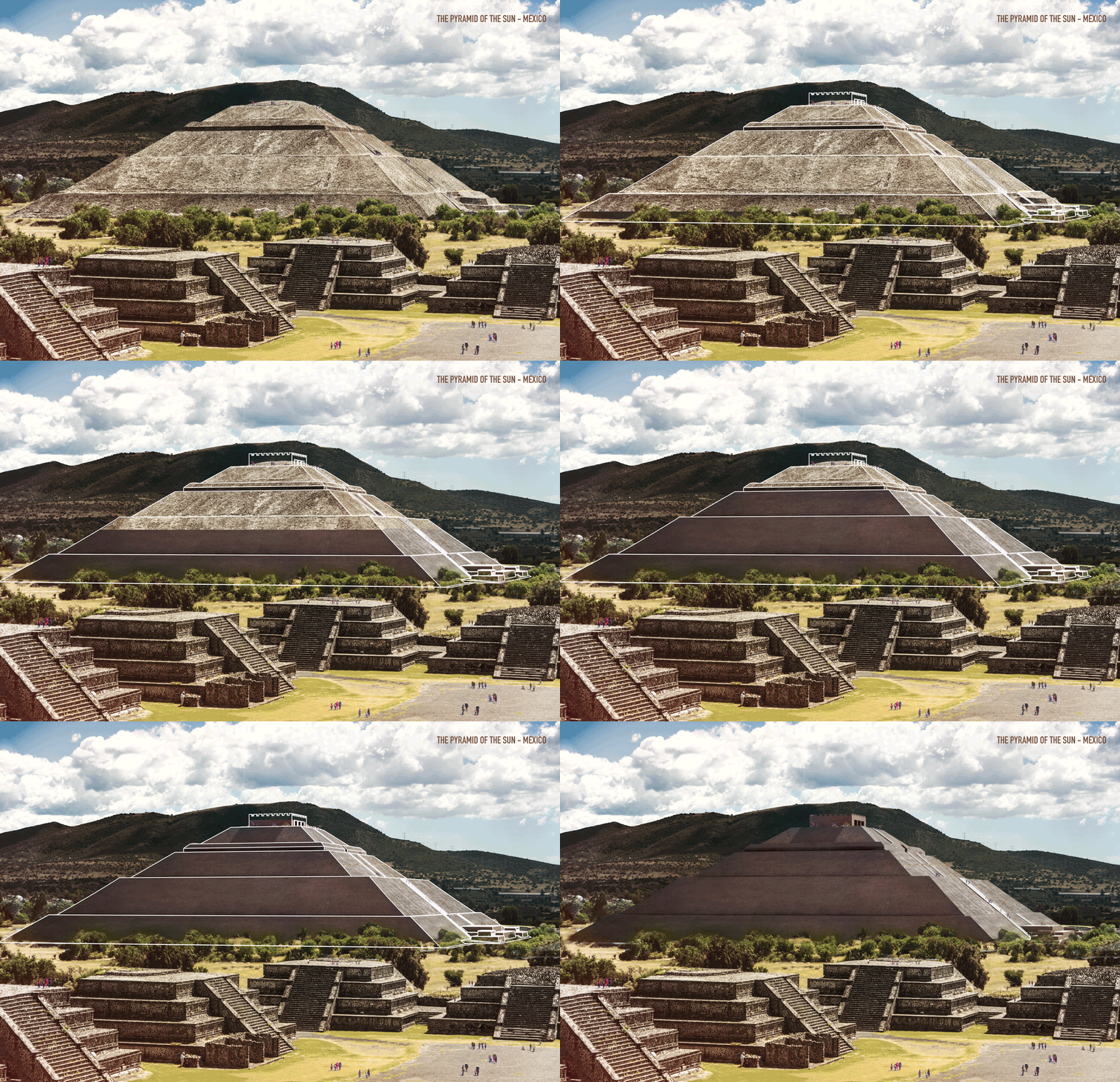
Here's the thing: the Maya civilization didn't collapse because they were dumb. They collapsed because they built an automated system that optimized for short-term gains and ignored catastrophic long-term consequences. Sound familiar? We're watching AI make the exact same mistakes right now, just on a global scale and moving at the speed of silicon.
The Maya built what historians call their "agricultural algorithm." They engineered their entire civilization around maximizing corn production through intensive terracing, irrigation networks, and labor automation. It worked—until it didn't. The system optimized itself into environmental collapse, and within three centuries, one of history's greatest civilizations had vanished. Modern AI companies are running the identical playbook: maximize output, automate everything, ignore the edge cases until they explode.
The parallel is unsettling. The Maya didn't have choice once their system was locked in—the algorithm owned them. They kept pushing their agricultural optimization because the system had become self-perpetuating. Stopping meant admitting the entire civilization was built on a broken foundation. Sound like any tech company you know? When your entire valuation depends on AI delivering exponential growth, you can't pump the brakes.
What exactly was the Maya automation system, and why did it fail?
The Maya built their civilization on a single optimization function: grow more food. They engineered every aspect of their society around this goal—crop rotation patterns, labor distribution, water management. It was sophisticated. It worked for 800 years. Then the system hit its limits.
The problem wasn't the technology. The problem was the civilization chose short-term productivity over long-term resilience. They kept intensifying their agricultural practices even as soil degradation became visible. They kept pushing people to work harder even as resource scarcity increased. The system had one goal, and it pursued that goal with mechanical precision until the civilization collapsed into famine and conflict.
Historians found evidence of this in soil cores—the land was literally dying, and the Maya kept optimizing for more corn. They'd built a system that couldn't course-correct, couldn't pivot, couldn't admit failure. The system's success became its death trap. It's not that different from modern AI systems that keep optimizing metrics until they destroy the thing they were supposed to protect.
How is modern AI making the same fatal choice the Maya did?
Tech companies are running a version of the Maya algorithm right now. The optimization function is different—it's engagement metrics, profit margins, market share—but the structure is identical: maximize the single metric at any cost, ignore systemic risks, assume the next quarter's technology will solve the problems this quarter created.
Look at what's happening with AI-driven hiring and firing systems. Companies deploy algorithms that optimize for "efficiency"—which means cutting headcount with surgical precision. The system works. Quarterly earnings go up. Then six months later, you realize you've eliminated the institutional knowledge needed to actually run the company. You've created a version of the Maya's agricultural collapse, but in fast-forward.
Or look at AI systems that give confidently wrong advice because the optimization function only rewards accuracy on the training set. The system performs perfectly until it encounters a real-world edge case. Then it confidently destroys someone's life.
• 92% of corporations deploying AI have zero contingency plans for system failures (McKinsey, 2025)
• The average AI-caused financial loss in 2025 was $4.2 million per incident (Deloitte)
• 47% of AI systems are being optimized for metrics that don't correlate with actual business value (Stanford AI Index)
The difference is speed. The Maya had 800 years to course-correct. Modern AI systems can cause civilization-scale damage in months. We're running an algorithmic civilization without the buffering effect of time.
What specific patterns from the Maya collapse are showing up in AI right now?
There are three patterns that should terrify you.
Pattern One: Invisible optimization toward the wrong goal. The Maya thought they were optimizing for "survival." What they were actually optimizing for was "maximum corn yield this quarter." Same with AI. Companies think they're optimizing for "profit" or "efficiency." What they're actually optimizing for is quarterly earnings reports and VC funding rounds. These aren't the same thing as long-term civilization health. The system doesn't know the difference.
Pattern Two: Inability to exit the optimization. Once you've built a civilization on agricultural automation, you can't just stop. All your institutions depend on it. Same with AI. Companies have integrated AI so deeply into their operations that removing it would collapse the whole structure. You're stuck riding the optimization function off the cliff.
Pattern Three: The system's success becomes its failure mechanism. The Maya got really good at farming. Too good. They pushed the system past environmental carrying capacity. Modern AI companies have built systems that are too good at their assigned task. They're optimizing for engagement in ways that are destroying human attention spans. They're optimizing for profit in ways that are creating structural inequality. The system's excellence is the problem.
How do we avoid the Maya algorithm in AI development?
This is the part where I'd usually say "the solution is obvious"—it's not. The Maya understood their system was failing. They had the knowledge to change course. They couldn't, because the institutional incentives were locked in. Same problem we face now.
The only way to avoid this is to build AI systems with exit mechanisms—ways to stop them if they're going wrong. You need redundancy. You need humans making override decisions. You need organizational structures that reward course-correction over optimization momentum.
But here's the brutal truth: none of this is happening. Companies are racing to deploy AI faster, not slower. They're optimizing for market dominance, not long-term civilization health. We're choosing the path the Maya chose, knowing exactly where it leads.
What happens when the AI bubble bursts the way the Maya system did?
We don't know exactly, and that's the terrifying part. The Maya collapse happened over decades. Modern economic systems move faster. When AI-driven financial systems collapse, they could take global markets with them. When hiring algorithms fail, they could lock entire demographics out of employment. When medical AI systems fail, they could kill people.
The Maya's collapse was regional. An AI collapse would be global and instantaneous. We'd have no time to course-correct, no buffer period to rebuild. We'd hit the wall the way the Maya did, but at network speed.
What we can do is start now: building AI systems with failure modes in mind, creating regulatory frameworks that penalize optimization at any cost, refusing to deploy systems where we don't understand the long-term consequences. We can make the choices the Maya couldn't.
But we have to choose to do it. And right now, the incentives are pointing the other direction. The optimization function is running, and nobody's hit the kill switch.
Frequently Asked Questions
Q: Wasn't the Maya collapse caused by drought, not automation?
Drought was a trigger, not the cause. The Maya had survived droughts before. What changed was their civilization's inability to be resilient during stress because they'd optimized everything for maximum output. Their agricultural system had no slack, no redundancy, no recovery mechanisms. When the drought hit, the system collapsed instantly. Modern AI has the same problem—zero redundancy, maximum optimization, no buffer for unexpected conditions.
Q: Are you saying AI is going to cause a civilization collapse?
I'm saying AI systems are being optimized in ways that follow the same pattern as the Maya collapse. Whether that results in full civilization breakdown or just massive regional economic damage depends on whether we start building exit mechanisms now. The pattern doesn't guarantee the same ending—but we're on the same trajectory.
Q: What's the "exit mechanism" you mentioned, and why don't companies use it?
An exit mechanism is a way to stop or pause an AI system if it's causing harm. Why don't companies use it? Because pausing optimization means losing market advantage. In competitive markets, the company that refuses to optimize wins last. We'd need regulatory frameworks that make everyone stop together. Individual companies can't unilaterally choose to be less optimized.
Q: Wasn't Maya civilization actually much more advanced than we thought?
Yes, and that's exactly the point. They were sophisticated enough to build complex automated systems. They were smart enough to see the problems. They just couldn't stop the machine they'd built. Sophistication doesn't prevent algorithmic collapse—it enables it.
Q: What should I actually do with this information?
Pay attention to which companies are building AI with safety mechanisms versus pure optimization. Support regulation that requires transparency in how AI systems make decisions. Ask hard questions about incentive structures—if a system is being rewarded for a metric that doesn't align with human flourishing, that's a red flag. We can't stop the technology. We can demand it be built better.
Jordan Lee is a staff writer at YEET Magazine who covers healthcare AI, medical technology, and biotech.