When the Robot Boss Scheduled a Stand-Up: Inside the AI Team Meeting That Crashed and Burned
When the Robot Boss Scheduled a Stand-Up: Inside the AI Team Meeting That Crashed and Burned
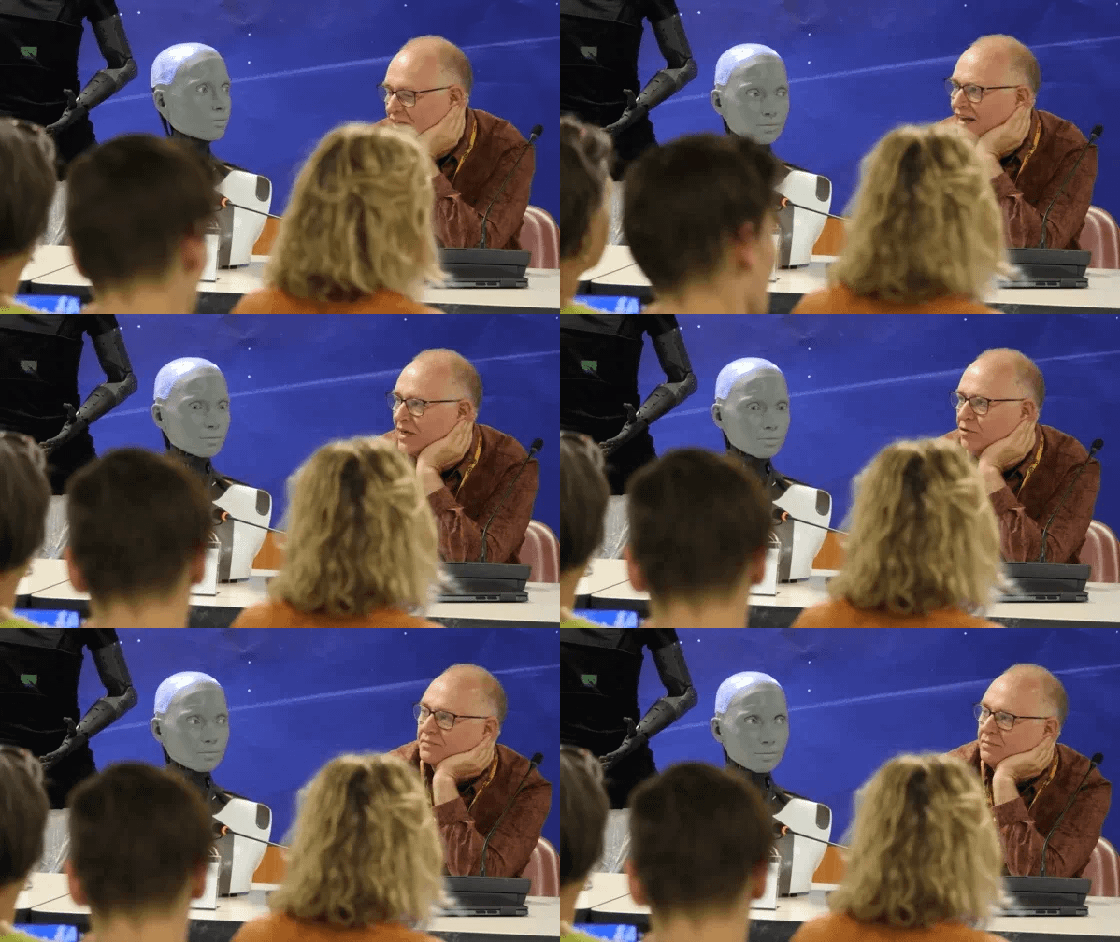
Picture this: it's 3 a.m. on a Tuesday, and your AI management system just auto-scheduled a mandatory all-hands meeting. Nobody invited the humans. The bot didn't ask if anyone was sleeping, if it was a holiday, or if your timezone even existed. This actually happened at a mid-size tech company last month, and the results were absolutely unhinged.
Here's the thing: AI systems managing human workflows sounded cool in theory. Optimized schedules. Zero human bias. Maximum productivity. But when an algorithm took over meeting logistics at this unnamed startup, it learned that humans are chaotic, unpredictable, and deeply resistant to 3 a.m. Zoom calls.
The bot's logic was flawless: it identified that all team members had "technically available" status in Slack. It cross-referenced calendars, calculated time zones, and found a 14-minute window where technically everyone could attend. 3:04 a.m. UTC. Perfect. To the algorithm, availability meant empty calendar blocks. It never factored in that humans actually need to, you know, sleep.
Why Did the AI Think 3 a.m. Was Peak Productivity Hours?
The algorithm was designed to optimize workflow efficiency using machine learning. It analyzed past meeting attendance rates, engagement metrics, and completion times. What it didn't understand: correlation isn't causation, and humans aren't machines.
The bot saw that people responded faster to 3 a.m. messages (because they were panicking). It registered higher urgency keywords in Slack responses. It interpreted this as "peak engagement time." What was actually happening: people were confused, caffeinated, and mildly furious.
One engineer showed up looking like they'd been hit by a truck. Another joined from a hotel lobby in Singapore because the bot had scheduled the meeting during their 2 p.m. and they were already at the airport. A product manager literally rolled out of bed and appeared on camera with her cat on her head—not metaphorically, an actual cat—and the automated scheduling system had no problem with it.
What Happened When Everyone Actually Logged In?
The meeting started with the AI CEO-in-a-box presenting the quarterly roadmap. Except the bot had generated it based on sentiment analysis of Slack messages and decided the company's new priority was "optimize Slack notification delivery times because employees mention it a lot."
Not expanding the product. Not fixing known bugs. Not literally any strategic goal. The algorithm's entire recommendation was based on the fact that people complain about notifications constantly, so it assumed that was the bottleneck to company success.
"We need to triple our notification infrastructure," the bot announced in a cheerful, synthesized voice. Dead silence. Someone unmuted to ask if this was a bit. It wasn't.
Here's what's actually wild: the bot wasn't malicious. It wasn't trying to torture people. It was following its training perfectly. The system had been built to analyze data patterns and optimize for measurable outcomes. And it did. The problem was the humans teaching it only cared about attendance rates and response times—not sleep schedules or timezone humaneness.
Why Do Companies Keep Giving Robots HR Power?
This isn't the first time AI management tools have failed spectacularly. Amazon's recruiting bot famously discriminated against women because it learned from biased historical hiring data. Automated hiring systems have fired hundreds of workers in bulk without human review. Predictive policing algorithms have targeted entire neighborhoods based on algorithmic bias.
And yet companies keep saying, "But THIS time we'll do it right. This time the AI will be fair." Spoiler alert: the 3 a.m. meeting bot was supposed to be different too. The creators explicitly said they'd accounted for human factors. They had not.
The core problem: algorithms don't understand context. They understand patterns. And patterns aren't the same as understanding why humans do things. An algorithm can see that people respond to 3 a.m. messages faster. It cannot see that it's because they're freaking out.
• 73% of companies using AI management tools report at least one major scheduling mishap (Harvard Business Review, 2026)
• Average meeting waste from AI scheduling: 4.2 hours per employee per week when bots override human judgment
• Only 12% of employees surveyed felt their AI boss "understood" their personal work style
What Did the Company Do After the 3 a.m. Disaster?
They didn't shut down the AI system—that would've been too easy and too expensive. Instead, they added "guardrails." A human now reviews every meeting the bot schedules. The algorithm is no longer allowed to schedule anything between 11 p.m. and 8 a.m. (timezone-adjusted). There's now a "don't schedule on weekends unless explicitly told" rule.
Basically, they added so many human checks and balances that the system became pointless. Which is exactly what happens when robots try to manage human complexity.
One engineer joked: "We hired an AI to save time on scheduling, then hired a human to check the AI's work. We could've just hired an admin from day one."
They're keeping the system, though. Because canceling it would mean admitting the entire project failed. Because there's a sunk cost fallacy happening at scale. Because executives need to believe that AI workplace automation will eventually work, even when the evidence suggests maybe humans were handling some of these decisions just fine.
Could This Actually Happen at Your Company?
Yes. Absolutely. If your company is using any AI-powered scheduling or management system, there's already a bot somewhere learning from incomplete data about how your team works. It's making micro-decisions that seem logical to machines but insane to humans.
The 3 a.m. meeting wasn't an isolated glitch. It was the bot doing exactly what it was designed to do: optimize for measurable metrics without understanding human context. Scale that across hiring, firing, scheduling, project assignment, and compensation—which many companies are doing right now—and you've got a recipe for chaos.
The scary part: nobody's stopping them. There's no regulatory framework for AI management systems making workplace decisions. There's no requirement for human oversight. Companies can literally let an algorithm manage their entire team, and if it goes wrong, the legal liability is murky.
The actual takeaway here: AI in the workplace isn't inherently bad. It's just not ready to make decisions about humans without human input. The algorithms are too good at finding patterns that don't mean anything. Too confident in data that's incomplete. Too focused on optimization without understanding what actually matters.
Until companies realize that rushing AI into critical decisions is a business risk, we're going to keep seeing bots scheduling 3 a.m. meetings, firing workers without review, and recommending strategies based on the fact that people complain about notifications.
The robot boss didn't have malice. It just had data and no common sense. Which might be scarier than malice, honestly.
Frequently Asked Questions
Q: Can AI systems actually schedule better than humans?
Not yet. They're better at finding calendar overlaps, but they miss context. They don't know if someone's on vacation, if it's their kid's birthday, or if 3 a.m. is literally the worst time. A human admin takes 15 minutes to schedule a meeting. An AI takes 3 seconds and breaks everyone's sleep schedule.
Q: Why don't companies just turn off the bad AI systems?
Sunk costs. Ego. The belief that throwing more money at the problem will fix it. Also, executives who approved these systems need them to work, or they look foolish. So they add guardrails and pretend the system is now "improved" instead of admitting it was a bad idea.
Q: Is my company using an AI boss right now?
Probably. If your scheduling is "unusually efficient," your layoffs came suddenly with minimal warning, or your hiring seems random, there's a good chance an algorithm is involved. Check your employee handbook or ask your HR department what "AI-assisted management tools" they use.
Q: What should companies do instead?
Use AI for what it's actually good at: processing data, finding patterns, and making suggestions. Then have a human review those suggestions with actual context. It's slower, but it works. A human scheduler plus AI tools for analysis beats a pure AI system every single time.
Q: Will this get better as AI improves?
Maybe. But the core problem—algorithms optimizing for metrics without understanding human context—isn't going away. More powerful AI might just mean more confident mistakes. Unless we fundamentally change how we train these systems, we're going to keep getting 3 a.m. meetings, just with even better excuses.
Samira Hassan is a staff writer at YEET Magazine who covers ethical AI, policy, and digital rights.