
US Consumer Debt Hits $18.25 Trillion — Credit Card Delinquencies Remain Elevated
Total US consumer debt stands at $18.25 trillion. Credit card balances are rising and delinquencies remain elevated.

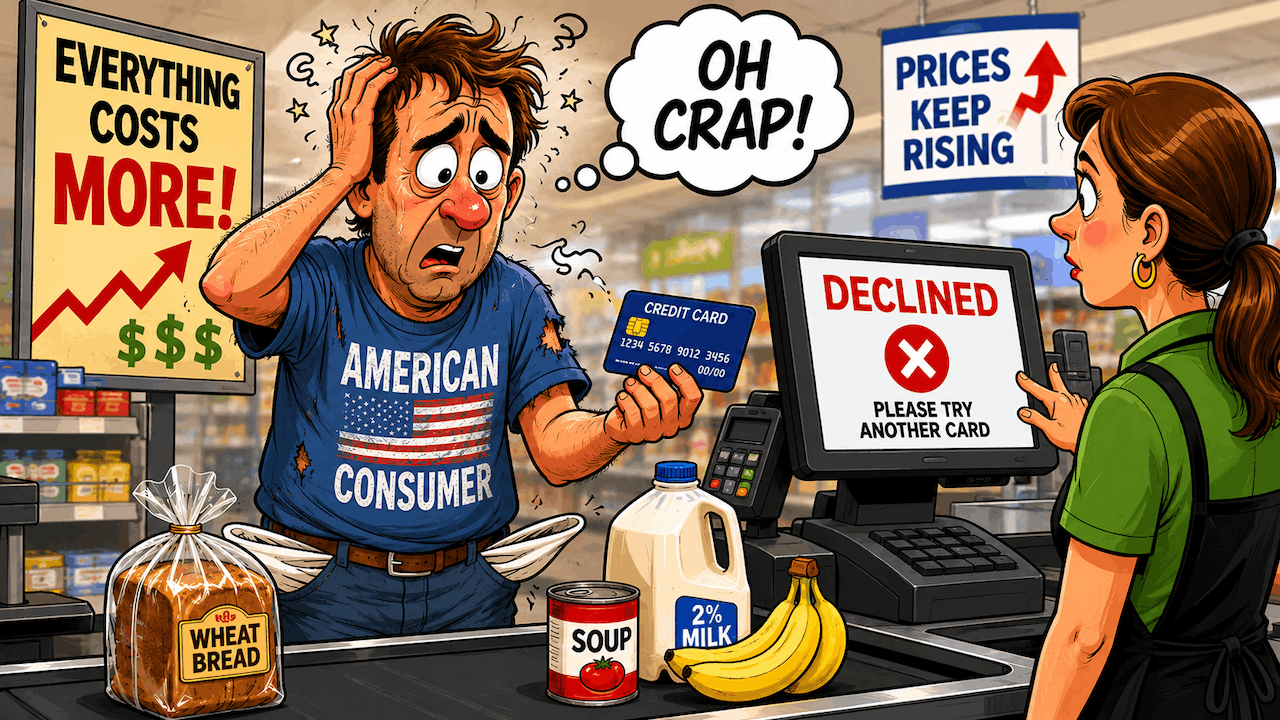
US Consumer Debt Hits $18.25 Trillion — Credit Card Delinquencies Remain Elevated
Total US consumer debt stands at $18.25 trillion, according to Equifax Q2 2026 data. Delinquency rates are improving across mortgages, auto loans, and credit cards, but credit card debt continues to climb.
Credit card debt rose 3.9 percent annually to $1.1085 trillion. Over a two-year window, bankcard balances have grown approximately 8.2 percent, outpacing cumulative inflation of 6.5 percent. That suggests real increases in credit card reliance.
For related coverage on financial stress, see our article on why full-time workers are becoming homeless in America.
What the Data Shows
According to the New York Fed's Q2 2026 Household Debt and Credit Report, credit card balances rose by $21 billion to $1.26 trillion. Auto loan balances increased by $28 billion to $1.71 trillion.
Transitions into early delinquency rose slightly for auto loans and mortgages but were largely steady for credit cards. Serious delinquency for credit cards remained at 6.97 percent.
For more on consumer financial stress, read our coverage of how many millionaires are in America and how ordinary people build wealth.
Why Reddit Is Panicking About This
If you've spent any time on r/economy, r/MiddleClassFinance, or r/Money lately, you already know people are stressed. Really stressed. The household debt report has been circulating for months and the comments tell a story that the headline numbers don't fully capture.
The big complaint: dual-income households making over $90,000 say their entire paycheck gets eaten up by mortgages, childcare, car maintenance, and minimum credit card payments. That's not a spending problem. That's a math problem.
One of the most repeated points in these threads is the "minimum payment trap" — the idea that a huge number of people don't understand how compound interest works. They treat credit cards like free money, pay only the minimum, and never shrink the balance. At an average APR around 21 percent, that's a treadmill you can't outrun.
Others talked about coping strategies. Strict cash-envelope budgeting. Aggressive side hustles. And in some darker threads, people discussing intentional default or debt settlement after burning out on high interest rates.
Delinquency Rates Are Catching Up
Here's the part that scares economists: roughly 4.8 percent of all US household debt is now delinquent — the highest overall rate since 2017. And for credit cards specifically, around 13.1 percent of balances are at least 90 days late. That's the highest share in 16 years.
The New York Fed noted that transitions into early delinquency rose slightly for auto loans and mortgages. Credit cards were largely steady. But "steady" at a nearly 7 percent serious delinquency rate is not good news. It means people are already deep in the hole.
What's driving this? Inflation. Rising costs. Wages that haven't kept up. And an economy where the cost of basics — housing, food, insurance, childcare — keeps climbing while paychecks stay flat.
Personal Finance and Debt Management Books
Learn how to manage debt and build financial stability with expert guidance.
Price: $16.99
Shop Now on Amazon →What This Means for the Average American
Let's break this down into questions people are actually asking:
How much debt do US consumers have? $18.25 trillion total. That includes mortgages, auto loans, credit cards, and student loans.
How much credit card debt is there? $1.26 trillion per the New York Fed. Roughly $1.1 trillion of that is bankcard debt.
Is $100,000 in debt a lot? Including mortgages, the average American household debt is around $104,755. Excluding mortgages, it's about $18,762. So context matters — but for credit cards specifically, average debt is around $6,700.
Is this normal in the US? High debt levels are common. But delinquency rates at 16-year highs are not normal. That's a warning sign.
The Middle-Class Squeeze Is Real
Reddit threads from r/MiddleClassFinance paint a brutal picture. Households making $90,000 to $120,000 — solidly middle class by any traditional measure — describe living paycheck to paycheck. After mortgage, childcare, car payments, insurance, and minimum credit card payments, there's nothing left. No savings. No emergency fund. No way out.
This isn't a spending problem. It's a structural problem. The cost of living has outpaced wage growth for decades. Credit cards have become a survival tool, not a luxury.
One Redditor in r/economy summed it up: "An explosion of household debt has put the US economy in a tough spot. Americans are borrowing more and saving less."
That's the cycle. And it doesn't end well unless something changes.