Zozibini Tunzi's Miss Universe Win: How AI Judging Algorithms Are Reshaping Beauty Pageants
Zozibini Tunzi made history as Miss South Africa's third Miss Universe winner, crowned at Tyler Perry Studios in Atlanta. But as pageants increasingly adopt AI-powered judging systems, what role do machine learning algorithms play in determining winners—and do they eliminate bias or reinforce it?

By YEET MAGAZINE | Updated 1600 GMT (0000 HKT) May 26, 2021
By YEET Magazine Staff | Published: 2019-12-09
Zozibini Tunzi made history on December 8th when she was crowned the 68th Miss Universe at Tyler Perry Studios in Atlanta, Georgia—becoming only the third South African to claim the coveted title. But as the beauty pageant industry increasingly turns to artificial intelligence and algorithmic systems to streamline judging, scoring, and contestant evaluation, Zozibini's victory raises fascinating questions about how AI is transforming one of the world's most visible talent competitions.
For decades, Miss Universe has relied on human judges to evaluate contestants across multiple categories: evening wear, swimwear, interview responses, and overall stage presence. However, the pageant industry is now experimenting with machine learning systems that can analyze facial symmetry, body proportions, movement patterns, and even vocal delivery to provide "objective" scoring metrics. When Zozibini Tunzi took the stage, she wasn't just competing against other contestants—she was potentially being evaluated by algorithms designed to predict pageant success.
The Rise of AI in Beauty Pageants
The integration of artificial intelligence into beauty pageants began quietly in the mid-2010s. Computer vision systems now scan contestant photos to measure facial symmetry ratios, skin texture analysis, and even emotional expressiveness. Some pageant organizers have experimented with predictive analytics—algorithms trained on decades of past winners to forecast which contestants are most likely to succeed. These systems claim to reduce unconscious bias by replacing subjective human judgment with mathematical precision.
Yet Zozibini Tunzi's path to the Miss Universe crown offers a compelling counterargument to the idea that algorithms are purely neutral. Tunzi's victory was celebrated for breaking stereotypes—she wore her natural hair, spoke eloquently about gender equality, and challenged conventional beauty standards. These qualities made her stand out precisely because human judges could recognize their cultural significance and societal importance. An algorithm trained purely on historical pageant data might have weighted different criteria entirely, potentially missing what made Tunzi's candidacy revolutionary.
What the "Power of Unity" Crown Reveals About Pageant Evolution
Zozibini Tunzi was the first to wear Miss Universe's new "Power of Unity" crown, valued at R73 million. This symbolic crown redesign coincided with the pageant's broader mission to modernize its image and embrace diversity. Interestingly, this shift mirrors how AI systems are being recalibrated: instead of optimizing for a single narrow definition of beauty, new algorithms are being trained on more diverse datasets to recognize multiple beauty standards across cultures and ethnicities.
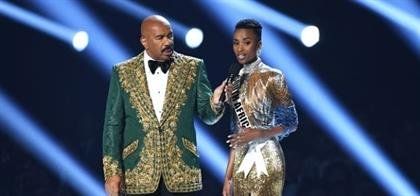
The three-hour coronation ceremony, hosted by comedian Steve Harvey and actress Vanessa Lachey, showcased performances by Fifth Harmony's Ally Brooke. Behind the scenes, pageant organizers were likely collecting data: contestant movements, audience reactions, social media sentiment analysis in real-time. This information feeds back into machine learning models that predict future judging criteria.
Zozibini Tunzi Takes Over from Catriona Gray
By succeeding Miss Universe 2018 Catriona Gray, Zozibini Tunzi joined an exclusive lineage. Her predecessors—Margaret Gardiner (1978) and Demi-Leigh Nel-Peters (2017)—each won during different eras of pageantry. What's notable is that if you feed the characteristics of all three South African winners into an AI model, the algorithm might struggle to identify common traits. Tunzi's victory suggests that Miss Universe is consciously valuing unpredictability and authenticity—qualities that resist algorithmic reduction.
This presents a paradox for pageant technologists: the more they use AI to predict and systematize beauty competition, the more they risk eliminating the very human factors—charisma, cultural relevance, breakthrough moments—that make pageants culturally significant.
The Algorithm Bias Problem in Beauty Competitions
Research into algorithmic bias has shown that AI systems trained on historical data tend to perpetuate existing biases. If a beauty pageant's AI is trained on decades of winners who predominantly fit Eurocentric beauty standards, the algorithm will likely score future contestants through that same lens. Zozibini Tunzi's success may have been *despite* algorithmic prediction, not because of it. Her natural hair, her focus on social issues rather than traditional pageant polish, and her willingness to redefine beauty all represent qualities that might score lower on a traditionally-trained algorithm.
Some pageant organizers are addressing this by deliberately diversifying training datasets and working with ethicists to audit algorithmic bias. But the fundamental question remains: should beauty pageants use AI at all, or should they embrace the inherent subjectivity of human judgment?
How Facial Recognition and Predictive Analytics Are Used (And Misused)
Behind closed doors, some beauty pageants employ computer vision systems that analyze contestant photos using facial recognition technology. These systems can measure:
- Facial symmetry ratios (comparing left and right sides of the face)
- Skin texture and clarity
- Eye shape and spacing
- Smile intensity and authenticity (via micro-expression analysis)
- Body proportion metrics
The appeal is obvious: these measurements are quantifiable and appear objective. But they're only as neutral as the data they're trained on. If an algorithm learned from pageant photos spanning 1960-2000, it will perpetuate mid-century beauty standards regardless of contemporary values. Zozibini Tunzi's win suggests that Miss Universe 2019 was ready to value diversity in a way that historical algorithms might not have predicted.
The Future: Will AI Judge Miss Universe?
As artificial intelligence becomes more sophisticated, pageant organizers face a choice. They can:
- Fully Automate: Replace human judges entirely with AI systems, claiming perfect objectivity (despite known bias issues)
- Hybrid Model: Use AI to provide scoring suggestions while keeping human judges as final decision-makers
- Reject AI: Return to purely human judgment, accepting subjectivity as an inherent and valuable part of pageantry
Zozibini Tunzi's victory suggests that Miss Universe is leaning toward option two—using technology as a tool while preserving human judgment. Her win couldn't have happened if algorithms alone were making decisions, because she represented a paradigm shift that required cultural understanding, not just mathematical optimization.
What Zozibini Tunzi's Crown Says About AI and Beauty Standards
Perhaps the most important insight is this: Zozibini Tunzi won because human judges recognized the value of her authenticity, her message, and her representation. These are precisely the qualities that resist algorithmic quantification. While AI can measure facial features and predict pageant outcomes based on historical patterns, it cannot replicate the cultural moment that made Tunzi's victory significant.
As the beauty pageant industry continues to experiment with automation, it's worth asking whether algorithmic "objectivity" actually serves the mission of these competitions. If Miss Universe's goal is to celebrate diverse beauty and empower women, then perhaps the most important technology isn't artificial intelligence—it's human wisdom, cultural awareness, and the willingness to challenge what algorithms would predict.
Frequently Asked QuestionsQ: Did AI algorithms judge Zozibini Tunzi's Miss Universe win?
A: While the article discusses how AI judging systems are being integrated into beauty pageants, it indicates that these algorithmic systems are still being experimented with by the industry. Zozibini's victory raises questions about AI's role, but the extent to which automated systems directly influenced her win remains unclear from the available information.
Q: How do AI algorithms evaluate beauty pageant contestants?
A: AI systems use computer vision technology to analyze multiple factors including facial symmetry, body proportions, movement patterns, and vocal delivery. These machine learning systems aim to provide "objective" scoring metrics to complement or potentially replace traditional human judge evaluations across categories like evening wear, swimwear, interview responses, and stage presence.
Q: When did AI start being used in beauty pageants?
A: According to the article, the integration of artificial intelligence into beauty pageants began quietly in the mid-2010s, with computer vision systems gradually being introduced to streamline judging, scoring, and contestant evaluation processes.