
Babi Yar Massacre: How Nazi Forces Murdered Nearly 34,000 Jews in Kyiv in Two Days
In September 1941, Nazi forces murdered nearly 34,000 Jewish people at Babi Yar, a ravine outside Kyiv, Ukraine. The massacre became one of the most devastating episodes of the Holocaust by bullets.

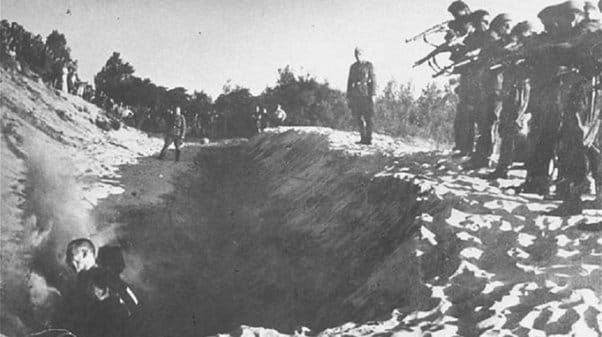
Babi Yar Massacre: Nearly 34,000 Jews Killed in Kyiv in Two Days
The Babi Yar massacre in Kyiv, Ukraine, remains one of the most devastating mass killings of Jewish people during the Holocaust.
On September 29 and 30, 1941, Nazi German forces and their collaborators murdered nearly 34,000 Jewish men, women, and children at a ravine known as Babi Yar.
The victims had been ordered to assemble with their documents and belongings after German forces occupied Kyiv.
Many were led to believe they were being relocated.
Instead, they were taken to Babi Yar, forced to surrender their belongings and clothing, and systematically shot.
The massacre demonstrated the brutality of the Holocaust in Eastern Europe and became one of the most infamous examples of mass murder carried out by Nazi mobile killing units. It sits alongside other histories of conflict and its aftermath that YEET Magazine has documented, including the mental health impact of war in Europe and our ongoing coverage of Chernobyl and Ukraine's historical memory.
What Happened at Babi Yar in September 1941?
German forces occupied Kyiv in September 1941 during the invasion of the Soviet Union.
Following the occupation, Nazi authorities issued orders directing Jewish residents to gather near a designated location.
They were instructed to bring identification documents, valuables, and other belongings.
Thousands of Jewish families arrived, expecting to be transported elsewhere.
Instead, they were marched toward Babi Yar, a ravine located outside the city.
German security police and members of mobile killing units, assisted by collaborators, carried out the mass executions.
The victims included children, elderly people, women, and men.
The killings continued over two days.
Approximately 33,771 Jewish people were murdered during the massacre on September 29 and 30, 1941.
The figure is one of the most extensively documented examples of mass murder during the Holocaust.
The Holocaust by Bullets in Eastern Europe
The Babi Yar massacre was part of a broader campaign known as the Holocaust by bullets.
Before and alongside the establishment of extermination camps, Nazi forces conducted mass shootings throughout occupied Eastern Europe.
Mobile killing units, known as Einsatzgruppen, followed German military advances and systematically murdered Jewish communities.
These units operated in territories occupied by Nazi Germany, including Ukraine, Belarus, and parts of the Soviet Union.
Their victims included Jewish civilians, Soviet prisoners of war, Roma people, political opponents, and other groups targeted by Nazi persecution.
The massacres often took place near towns and villages, using ravines, forests, and other locations as execution sites.
Babi Yar became one of the most recognizable locations associated with this phase of the Holocaust. Understanding this history is part of a wider reckoning with how societies remember atrocity, a thread that runs through our reporting on tracking war crimes and the Sarajevo sniper tourists and the structures that enable collective harm.
How Many People Were Killed at Babi Yar?
Approximately 33,771 Jewish people were murdered at Babi Yar on September 29 and 30, 1941.
However, the massacre did not end after those two days.
Nazi forces continued using the ravine as an execution site during the occupation of Kyiv.
Additional victims included Roma people, Soviet prisoners of war, Ukrainian nationalists, and other civilians.
The total number of people murdered at Babi Yar during the Nazi occupation is generally estimated at approximately 100,000 or more.
The exact number remains difficult to establish because many victims were never individually identified and Nazi authorities attempted to conceal evidence of their crimes.
The location therefore represents both the mass murder of Kyiv's Jewish population and the wider Nazi campaign of extermination in occupied Ukraine.
How Nazi Authorities Tried to Conceal the Babi Yar Massacre
As Nazi Germany began losing control of occupied territories, German authorities attempted to destroy evidence of mass executions.
At Babi Yar, prisoners were forced to exhume bodies and participate in the destruction of evidence.
The operation formed part of a wider Nazi effort to conceal mass killings across Eastern Europe.
The perpetrators sought to prevent the discovery of mass graves and the documentation of their crimes.
Despite these efforts, evidence survived through eyewitness testimony, investigations, historical records, and the accounts of survivors.
The scale of the massacre eventually became an important part of Holocaust documentation.
Why Babi Yar Was Suppressed During the Soviet Era
After World War II, the Soviet Union did not consistently recognize the specifically Jewish dimension of the Babi Yar massacre in public commemorations.
Official narratives often emphasized the murder of Soviet citizens rather than identifying Jewish victims as the principal targets of the September 1941 executions.
This approach reflected the broader Soviet policy of suppressing distinct expressions of ethnic and religious identity in public historical memory.
For years, commemorations at Babi Yar faced political restrictions.
The ravine itself was also subjected to major changes.
In the 1950s, Soviet authorities began projects involving the area, including the construction of a dam and the use of the ravine for industrial purposes.
The site was eventually transformed, and parts of the original landscape were substantially altered.
These developments contributed to decades of controversy over how the massacre should be remembered.
Babi Yar Became a Symbol of Holocaust Remembrance
Babi Yar is now recognized as one of the most important Holocaust memorial sites in Ukraine.
The massacre remains a powerful reminder of what happened when Nazi antisemitism became state policy and systematic violence.
It also represents the destruction of Jewish communities throughout Eastern Europe.
The victims were not anonymous numbers.
They were families, children, parents, grandparents, and individuals whose lives were destroyed during the Holocaust.
Remembering Babi Yar means recognizing the specific history of the Jewish people murdered there, as well as the other victims of Nazi persecution.
The site continues to play an important role in Holocaust education and remembrance. Memorial work like this is closely tied to broader questions of memory and identity, which we explored in how photography became art and a tool of historical witness and the mysteries and secrets of the Mona Lisa.
Why the Babi Yar Massacre Still Matters Today
The Babi Yar massacre is a warning about the consequences of antisemitism, racial persecution, and state-sponsored violence.
The killings were organized, documented, and carried out by people operating within a system that treated entire communities as targets for extermination.
The massacre also demonstrates that the Holocaust was not limited to concentration camps and gas chambers.
Across Eastern Europe, thousands of Jewish communities were destroyed through mass shootings and other forms of systematic murder.
Babi Yar remains one of the clearest examples of that history.
Remembering the nearly 34,000 Jewish people murdered there in September 1941 is essential to understanding the Holocaust and preserving the historical record.
The ravine became a symbol of the lives destroyed, the families erased, and the responsibility to ensure that such crimes are never forgotten.