Why Did Actress Anne Hathaway Gives Up Veganism?Veganism Pros and Cons, Learn Veganism benefits.
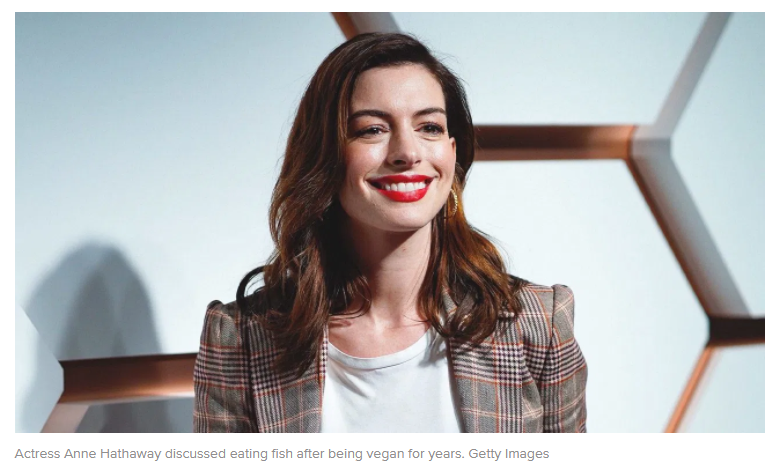
Anne Hathaway went viral after admitting she gave up veganism because she felt weak, tired, and literally drained. But here’s what no one’s saying: her decision might have been predicted by AI before she even made it.

I use to be a vegetarian, but recently I started eating meat and I have more energy now. Is that normal?
Why do some people return to eating meat after they have been vegetarian for many years?
The body absorbs animal iron far more efficiently than plant iron. You’re not the first person to mention how they felt after leaving vegetarianism or veganism and definitely won’t be the last.
Why choose vegetarianism in the first place?
1. Morality: They may come to believe that consuming products made through the use of animals is immoral. They may come to believe that animal agriculture is damaging to the environment, and therefore harmful to all.
2. Health: They may come to believe that eating animal products is bad for their health. Sometimes this is selective, such as those who still consume fish or dairy.
3. Taste: Some people simply don't like the taste of meat.
Of those primary motivators, health and taste carry with them very little external influence. Morality is different in that it isn't just a personal choice. It's a choice made around the external influences. And it's a motivator that extends beyond individual self interest, to judgement and a drive to influence others.
Given those general reasons for choosing to impose significant limitations on choice and ease of obtaining daily necessities, it would stand to reason that the weakening of those beliefs would be at least partly responsible for any choice to return to omnivorism.
A person motivated by morality might acknowledge that there is no perfect option for doing no harm to other living beings. They might then become convinced that some animal products, with consideration to the process by which they are created, have a smaller net impact on the suffering of sentient beings than equivalent non-animal products.
There is for example a growing trend for the consumption of pasture raised cattle and other ruminants as a means of significantly lowering, perhaps to the point of reversing, the damage to the environment, and nearly eliminating damage to wildlife that conventional farming causes.
A person motivated by health may come to believe that selectively including some animal products in their diet is more beneficial to their health than complete exclusion. They may find that it's too difficult or too expensive to create a healthy diet for themselves, failing to thrive without animal products.
And for taste, some people simply start liking things they didn't like before.
Where those are some of the motivations for being vegetarian, strong or weak, these are motivations for not.
Doing anything that isn't common in the area where one lives is usually much more difficult and costly in time and/or money than doing the locally common activity.
Vegetarianism and more so veganism impact the options a person has each and every day. In a culture that has a very low ratio of vegetarians, finding a meal prepared by someone else without meat, yet with a healthy ratio of macronutrients is very difficult. It often means limiting the menu to side dishes, or some specially offered option like a burger, but with a patty made from beans, or a large mushroom.
Cultures that don't often have to provide for the preferences of vegetarians make interacting in situations around food difficult. Whenever a vegetarian eats in most of rural america for example, they are given strange looks and required to explain things like how they don't want the vegetable soup if it has beef broth in it. The wait staff then has to go check with the cook, who then has to find the can and read the label. At the end of this tiny interaction, the vegetarian is often seen as difficult, and perhaps pretentious for being so "special" and particular.
For vegans it's even harder. A vegan may choose to not buy a pair of jeans if it has a leather tag on the back. They may research which restaurants have breads without eggs as a binder, or milk as softening agent. They may choose a brand of sugar that doesn't use bone char for filtering in the process. All of this takes a significant amount of work in research and procurement. It often comes at a much higher financial cost because the specialty industries that deliberately forgo the use of animal products, and make an effort to communicate that, are small in number, and small in scale.
Going out with friends who are not vegetarian, in a place where it's rare to find good vegetarian options means having poor choices on the menu and perhaps going hungry, or having the group of friends all make concessions for the one vegetarian by going to a restaurant that they would prefer. Friends are often willing to do this, but it is a social burden and essentially feels like a favor being required for every interaction involving food.
While it is certainly possible to live as a vegetarian or vegan without higher costs in time or money, and it's possible to have a social life where there isn't the constant need to receive special treatment by everyone else, it's far from common and usually requires deliberate choices to relocate geographically, and to rely more on personal production than taking advantage of industry and the division of labor.
Many people who at some point choose vegetarianism and then later go back to omnivorism do so because after living it for a while they find the trade offs to be too much for the benefits they perceive.
I won't go into the internal conflict this often involves. I won't talk about the social ramifications a "fallen vegetarian" has to deal with from their former "vegetarian support group". I won't delve into the complex relationship they continue to have with food choices the rest of their lives.
Suffice it to say that for the vast majority of those in western culture, vegetarianism at any level of dedication makes daily life harder.
When someone has to balance how those choices impact the rest of their lives and aspirations, they may come to the conclusion that for their personal situation, choosing vegetarian is not the sacrifice they want to make.
This is obviously a hugely personal topic. It obviously has impact for others through their sense of morality, and causes them pain in knowing the suffering caused by the choices that are different than theirs. But like so many things in life, if there were a clearly best option for everyone, we would all be doing it.
What complicates the issue more is that the system of individual choices often goes counter to the best interests of the individuals, and even the system.
It could be that if everyone were vegan, food shortages would not be an issue until population rose much higher. It could be that some quantification of universal suffering would decrease. It could be that humans on average were significantly healthier and happier.
But the present state of the social and economic system requires individuals who wish to live that lifestyle now to make sacrifices in choice and sometimes health, for what may still sometimes have a net result against their desired outcomes due to the lack of scale, the social segregation, and the far from perfect knowledge of how to thrive in so different a way.
The morally motivated once vegetarian gone omnivore lives in the knowledge that their choices are always a trade off in some way. They don't always think about every choice so carefully as they used to, because even that energy spent thinking is a trade off, but they do have a clearer understanding through experience what those choices mean in the complex interactions of the system that provides for our needs.
Vegetarianism and veganism as choices made for morality are, in my mind, continuous acts of courage and sacrifice. Those choices do have a huge impact in reducing the suffering of animals. But they aren't easy choices. And they come with trade-offs personally and in the wider system.
When a person who is able to consider their external impact as it ripples through the chain of events has to make decisions, it's tempting to identify some line to never cross. It's tempting to see a decision as binary, clear, simple. Our minds rely on simplification and modeling constantly in order to move forward in any action without traversing deep into the infinite branching of cause and effect.
The level of detail in the bends of those lines, and the willingness to re-evaluate the boundaries when new information arrives, are the factors involved in the change a person goes through as their heart craves comfort and joy for themselves and others, and their mind tries to find the best path through the complex and conflicting options.