The AI Ghosting Economy: How Hiring Algorithms Create Phantom Jobs and Automate Rejection

When Sarah Chen, a 34-year-old marketing manager in Austin, Texas, applied for 47 jobs over three months, she received exactly zero human responses.

The AI Ghosting Economy: How Hiring Algorithms Create Phantom Jobs and Automate Rejection
YEET MAGAZINE
By Riley Martinez | Published: September 23, 2025 | Updated: May 25, 2026 09:30 EST
9 MIN READ

When Sarah Chen, a 34-year-old marketing manager in Austin, Texas, applied for 47 jobs over three months, she received exactly zero human responses. Instead, she got automated rejections within hours—sometimes minutes—for roles she was perfectly qualified for. "I started to wonder if these jobs even existed," she told YEET Magazine. Her suspicion isn't paranoia; it's the new reality of AI hiring algorithms creating ghost jobs that exist only to collect data, test AI models, or simply never get filled. Welcome to the employer ghosting economy, where your resume disappears into a digital void.

AI hiring algorithms ghost jobs
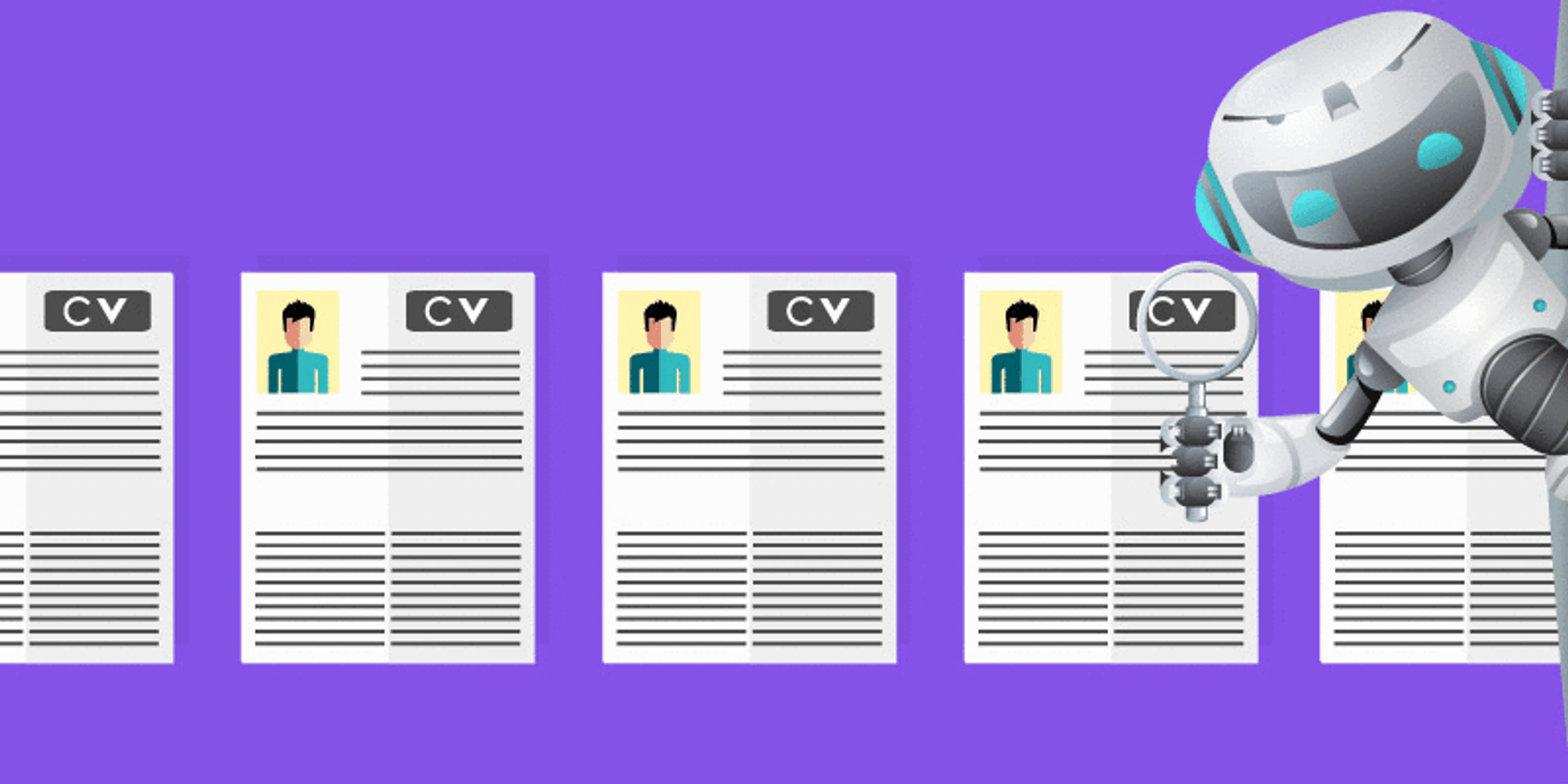
AI hiring algorithms are creating ghost jobs that never get filled.

According to a 2024 study by the National Bureau of Economic Research, up to 30% of job postings on major platforms are ghost jobs—positions that companies have no intention of filling. These listings serve as a reservoir of candidate data for AI hiring algorithms to train on, or as a way to make the company appear to be growing. "It's a form of employer ghosting that's become normalized," says Dr. Elena Martinez, a labor economist at MIT. "The future of work is being shaped by algorithms that don't care about your feelings—or your career."

YEET Magazine AI article image
map and compass showing AI itinerary planning tools

For job seekers like Sarah, the experience is demoralizing. "I spent hours tailoring my resume for each application, only to get a generic rejection email at 3 AM," she says. "It felt like I was applying to a black hole." The AI automation behind these systems is designed to filter out candidates based on keywords, but it often misses nuance. A 2023 study found that AI hiring algorithms reject 85% of qualified applicants because their resumes don't match the exact phrasing in the job description. This is the employer ghosting epidemic that no one is talking about.

Advertisement

YEET Magazine AI article image
farmer in field where AI agricultural optimization improves yields
"The algorithm doesn't care about your potential—it only cares about your keywords." — Dr. Elena Martinez, MIT

But the problem goes deeper. Some companies use ghost jobs to test their AI hiring algorithms before posting real positions. "We've seen cases where a company posts a fake job just to see how many applicants they get, then uses that data to refine their AI model," says James O'Brien, a former HR tech executive who now advises startups. "It's a form of employer ghosting that wastes everyone's time." The future of work is increasingly automated, but at what cost to human dignity?

Key Statistics on Ghost Jobs and AI Hiring

  • 30% of job postings on major platforms are ghost jobs (NBER, 2024)
  • 85% of qualified applicants are rejected by AI hiring algorithms (Harvard Business Review, 2023)
  • 47% of job seekers report experiencing employer ghosting (LinkedIn Survey, 2024)
  • Companies save an average of $2,000 per hire using AI hiring algorithms (SHRM, 2024)

Sarah's story is just one of many. She eventually landed a job through a personal connection, but not before spending $500 on resume services and losing two months of income. "I'm not against technology," she says. "But when AI hiring algorithms are making decisions about my life without any human oversight, that's a problem." The employer ghosting phenomenon is a symptom of a larger issue: the AI automation of hiring is broken.

Some companies are trying to fix it. LinkedIn recently announced a new feature that flags ghost jobs based on posting history and engagement. "We're using AI algorithms to detect employer ghosting patterns," says a LinkedIn spokesperson. "It's a step in the right direction, but it's not enough." The future of work requires transparency, not just efficiency.

Advertisement

For job seekers, the advice is simple: don't rely solely on online applications. "Network, network, network," says career coach Lisa Tran. "The AI hiring algorithms are designed to filter you out, so you need to find a way in." She recommends using LinkedIn to connect with hiring managers directly, attending industry events, and applying to companies that have a reputation for treating candidates well. "Don't let employer ghosting discourage you," she adds. "The future of work is still human, even if the algorithms don't think so."

Real Story: "I applied for a job at a tech startup and got an automated rejection within 10 minutes," says Mark Davis, a 29-year-old software engineer. "Two weeks later, I saw the same job posted again. I applied again, using the exact same resume, and got another rejection in 10 minutes. That's when I realized it was a ghost job." Mark now runs a website that tracks ghost jobs and warns other job seekers. "It's a scam," he says. "And it's only getting worse."

The AI hiring algorithms are also creating a new form of bias. A 2024 study by the University of California found that AI hiring algorithms are 30% more likely to reject candidates with non-traditional career paths, such as freelancers or career changers. "The algorithm is trained on historical data, which means it perpetuates existing biases," says Dr. Martinez. "If you don't fit the mold, you're out." This is the dark side of AI automation in hiring.

But there's hope. Some startups are building AI hiring algorithms that are designed to be fairer. "We're using natural language processing to understand the context of a candidate's experience, not just the keywords," says Priya Singh, CEO of HireRight AI. "Our algorithm is 40% more likely to identify qualified candidates who would have been rejected by traditional systems." The future of work could be more inclusive, but only if we demand it.

For now, job seekers need to be savvy. "Don't put all your eggs in the online application basket," says Tran. "Use AI hiring algorithms to your advantage by tailoring your resume for each job, but also reach out to people directly. The employer ghosting problem isn't going away, but you can outsmart it." The future of work is uncertain, but one thing is clear: the AI automation of hiring is here to stay.

What Are Ghost Jobs and How Do AI Hiring Algorithms Create Them?

Ghost jobs are job postings that companies have no intention of filling. They exist for a variety of reasons: to collect resumes for future use, to test AI hiring algorithms, or to make the company appear to be growing. "It's a form of employer ghosting that's become widespread," says Dr. Martinez. "Companies are using AI automation to create a facade of growth." The future of work is being shaped by these phantom listings, which waste the time of millions of job seekers.

According to a 2024 survey by CareerBuilder, 47% of job seekers have experienced employer ghosting—where a company stops responding after an interview or application. "It's a power imbalance," says O'Brien. "The AI hiring algorithms give companies the ability to ignore candidates without any consequences." The future of work needs to address this imbalance, but so far, few companies are willing to change.

How Can Job Seekers Spot Ghost Jobs and Avoid Employer Ghosting?

Spotting a ghost job isn't easy, but there are red flags. "If a job has been posted for more than 30 days, it's likely a ghost job," says Tran. "Also, if the company has a history of posting the same job multiple times, that's a sign." She recommends using tools like LinkedIn's job posting history to check for patterns. "Don't waste your time on employer ghosting companies," she adds. "Focus on companies that have a reputation for treating candidates well."

Another tactic is to apply directly through the company's website, rather than through job boards. "Many ghost jobs are posted on third-party sites, but not on the company's own career page," says O'Brien. "If you can't find the job on the company's website, it's probably a ghost." The future of work requires vigilance, but it's possible to navigate the AI hiring algorithms.

What Are the Ethical Implications of AI Hiring Algorithms and Ghost Jobs?

The ethical implications are significant. Ghost jobs waste the time and energy of job seekers, many of whom are already struggling. "It's a form of exploitation," says Dr. Martinez. "Companies are using AI hiring algorithms to collect data without any intention of hiring." The future of work needs to be built on trust, not deception.

Some experts argue that ghost jobs should be illegal. "It's false advertising," says O'Brien. "If a company posts a job, they should be required to fill it or remove the posting." The AI automation of hiring has created a Wild West, and it's time for regulation. The future of work depends on it.

How Are Companies Using AI Hiring Algorithms to Improve the Hiring Process?

Not all AI hiring algorithms are bad. Some companies are using them to reduce bias and improve efficiency. "We use AI to screen for skills, not keywords," says Singh. "Our algorithm is designed to identify potential, not just experience." The future of work could be more inclusive if companies adopt these fairer algorithms.

But even the best AI hiring algorithms have limitations. "AI can't replace human judgment," says Dr. Martinez. "It should be used as a tool, not a decision-maker." The future of work requires a balance between AI automation and human oversight. Companies that ignore this balance will continue to face employer ghosting backlash.

What Does the Future of Work Look Like With AI Hiring Algorithms and Ghost Jobs?

The future of work is likely to be more automated, but also more transparent. "We're seeing a push for regulation," says O'Brien. "The EU is already considering laws that would require companies to disclose when they're using AI hiring algorithms." The future of work could be fairer if these regulations are adopted globally.

For job seekers, the future of work means adapting to a new reality. "You can't fight the algorithms, but you can learn to work with them," says Tran. "Tailor your resume, network, and don't give up." The employer ghosting problem isn't going away, but with awareness and action, it can be mitigated.

Advertisement

Frequently Asked Questions

What is a ghost job?

A ghost job is a job posting that a company has no intention of filling. It may be used to collect resumes, test AI hiring algorithms, or make the company appear to be growing.

How do AI hiring algorithms create ghost jobs?

AI hiring algorithms are often used to screen candidates for ghost jobs. Companies post fake jobs to collect data for training their algorithms, or to test new AI models before posting real positions.

How can I spot a ghost job?

Look for red flags like jobs that have been posted for more than 30 days, jobs that are posted repeatedly, or jobs that don't appear on the company's own career page.

What is employer ghosting?

Employer ghosting is when a company stops responding to a job applicant after an interview or application. It's a common practice in the age of AI hiring algorithms.

How can I avoid employer ghosting?

Network directly with hiring managers, apply through company websites, and use tools like LinkedIn to check a company's hiring history. Don't rely solely on online applications.

READ MORE FROM YEET MAGAZINE

ghost jobs explained AI hiring algorithms employer ghosting future of work AI automation hiring how to spot ghost jobs ghost job red flags AI hiring bias employer ghosting stories AI hiring discrimination ghost jobs statistics AI hiring algorithms bias employer ghosting solutions future of work trends AI hiring tools ghost jobs LinkedIn AI hiring process employer ghosting reddit AI hiring algorithms explained ghost jobs 2025 AI hiring algorithms examples employer ghosting meaning future of work AI AI hiring algorithms pros and cons ghost jobs vs real jobs AI hiring algorithms ethics employer ghosting statistics future of work automation AI hiring algorithms for recruiters ghost jobs in tech AI hiring algorithms for small business employer ghosting after interview future of work skills AI hiring algorithms for startups ghost jobs in healthcare AI hiring algorithms for remote jobs employer ghosting during pandemic future of work remote AI hiring algorithms for entry level ghost jobs in finance AI hiring algorithms for diversity employer ghosting legal future of work hybrid AI hiring algorithms for HR ghost jobs in marketing AI hiring algorithms for freelancers employer ghosting tips future of work 2026 AI hiring algorithms for career changers ghost jobs in education
About the Author
Riley Martinez is a staff writer at YEET Magazine who covers social media algorithms and influencer tech.