
How Did Alberta Become the Center of a Global Power Struggle? Oil, Separatism, and the 51st State
Alberta holds most of Canada's oil and critical minerals. That combination has turned a provincial grievance into a target for foreign influence, separatist organizing, and great-power resource competition.

YEET Magazine
How Did Alberta Become the Center of a Global Power Struggle? Oil, Separatism, and the 51st State
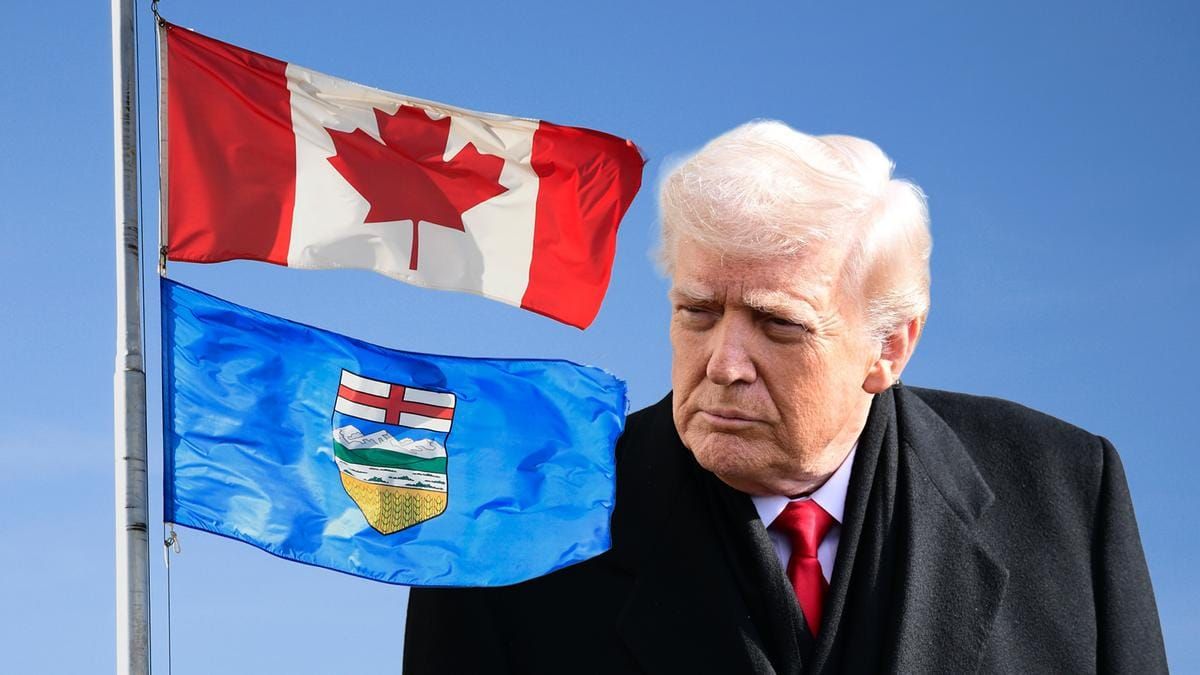
Alberta is not a global power. But it sits on 84 percent of Canada’s oil production and some of the largest recoverable rare-earth and critical-mineral deposits in the Western Hemisphere. That combination has turned a provincial grievance into a target for foreign influence operations, a live experiment in resource-driven separatism, and a pressure point in the larger contest over energy, minerals, and sovereignty.
The province’s strategic weight is not abstract. Canada is one of the few Western countries that can still expand oil production at scale. Alberta’s oil sands remain the largest single source of that growth. At the same time, the province holds significant reserves of lithium, uranium, and rare earths that the United States, Europe, and Asia all need for batteries, reactors, and advanced electronics. Whoever shapes Alberta’s political future shapes access to both hydrocarbon and non-hydrocarbon resources in North America.
That reality has not gone unnoticed. Russian state-linked and proxy networks have repeatedly injected the “51st state” narrative into English-language media ecosystems, using AI-generated content to seed search results, social feeds, and large-language-model training data. The goal is not to make Alberta leave Canada tomorrow. It is to keep the idea circulating, to erode the sense that Canadian territorial integrity is settled, and to force Ottawa to spend political capital on internal cohesion instead of external strategy.
American conservative networks have amplified the same themes from a different direction. High-profile influencers have floated petitions, podcast discussions, and social-media campaigns treating Alberta independence as a natural extension of American energy interests and cultural affinity. The messaging is less about Russian destabilization and more about “energy independence” and “freedom from Ottawa.” The effect is complementary: the same question keeps getting asked from multiple angles.
The political infrastructure on the ground is real. The Alberta Prosperity Project, the most organized separatist vehicle, has held meetings with U.S. State Department officials and has publicly floated the idea of a massive credit facility from the U.S. Treasury to underwrite a transition to independence. Premier Danielle Smith has cultivated relationships across the American right, appearing in MAGA-aligned media and framing federal-provincial disputes in language that travels easily south of the border. Separatist figures have been received by American media personalities who treat the idea as plausible rather than fringe.
The referendum mechanism itself is carefully staged. The first vote would not be on independence. It would be on whether to hold a later referendum on independence. This two-step process is designed to lower the psychological barrier. A soft question normalizes the hard one. Brexit showed how quickly a “protest vote” can become irreversible once the formal machinery is activated.
Current polling still runs against the separatists. Roughly seven in ten Albertans say they want to remain in Canada; support for independence hovers around one in five. Those numbers are not fixed. Economic frustration, pipeline delays, federal carbon policy, and perceived cultural distance from Central Canada have kept the baseline of Western alienation high for decades. A sharp economic shock or a high-profile federal overreach could move the numbers quickly. The infrastructure for that movement already exists.
The stakes extend far beyond Alberta’s borders. A serious independence crisis would test Canadian federalism at a moment when the country is already managing Arctic claims, Indo-Pacific commitments, and U.S. trade volatility. It would also set a precedent for other resource-rich regions watching how far internal divisions can be pushed by external actors. Energy markets, critical-mineral supply chains, and the credibility of North American political stability would all be affected.
For the larger resource and currency contest this sits inside, see why the petrodollar matters and the conflict that defines this decade.
What do you think? Is Alberta’s separatist current a legitimate expression of regional discontent, or has it become a useful pressure point for actors who benefit from Canadian fragmentation? Share your answer.
Sources: Radio-Canada; BFMTV; IRIS; YEET Magazine