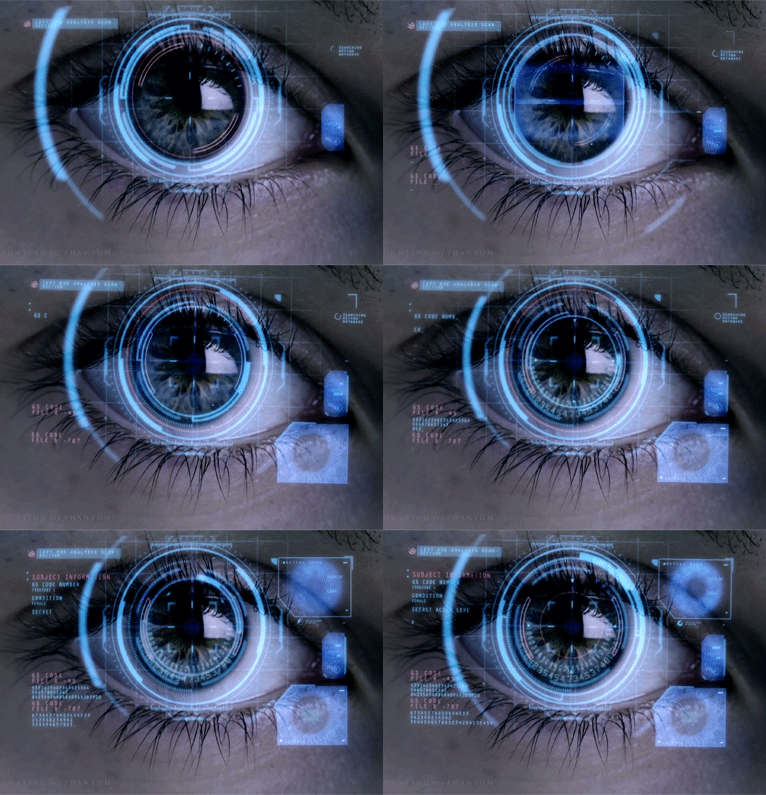
Will Humans Develop New Eyes in the Future?
Human eyesight may evolve as people spend more time on screens, artificial lighting, and virtual reality. This article explores how human vision could change in the future.

AI / Science / Tech / Internet Culture / Future / Viral / Explainers
By YEET Magazine Staff, YEET Magazine
Published April 14, 2026
Human vision is already under pressure
Human eyes evolved for a natural world:
- sunlight
- distance viewing
- constant movement outdoors
Today, most people live in a very different environment:
- screens up close
- artificial lighting
- indoor spaces
This shift is important because eyes adapt to how they are used.
Screens are changing how we use vision
Modern vision is dominated by close-range focus.
People now spend hours:
- staring at phones
- working on laptops
- switching between small digital targets
This can affect:
- focus speed
- eye strain levels
- long-distance vision habits
Over long periods, usage patterns influence adaptation.
Could humans develop different types of eyes?
If future environments continue to change, vision may also shift.
Possible directions include:
- stronger near-focus ability
- reduced sensitivity to natural daylight
- improved low-light adaptation for indoor life
- better tracking for digital movement and screens
These are not immediate changes, but long-term possibilities.
Virtual reality and the biggest unknown
Virtual reality could change vision more than smartphones ever did.
If humans spend large portions of life in simulated environments:
- natural depth perception may become less important
- artificial visual systems could become dominant
- eyes may adapt to hybrid real-digital input
At that point, biological vision and digital vision could overlap.
Could eyesight become less important?
In a highly technological future, vision may no longer be the main way humans interact with information.
Instead, people may rely on:
- audio input
- brain interfaces
- direct neural signals
If that happens, eyes may become less central to daily life.
Conclusion
Human eyes will not disappear, but they will likely adapt.
The most realistic changes are:
- different focus patterns
- adaptation to artificial environments
- reduced dependence on natural lighting
- gradual shift toward digital-centered vision
The future of human eyesight is not about losing vision.
It is about changing what vision is used for.
It may simply be built for a different world.
🔗 Related reads
 YEET MAGAZINE
 YEET MAGAZINE
 YEET MAGAZINE